
Why DFARS 252.204-7012 Applies to IT Service Providers—Not Just Prime Contractors
If your company provides managed IT, cloud hosting, software development, helpdesk support, or any other technology service to a defense contractor, you are almost certainly subject to DFARS 252.204-7012 compliance obligations. Many IT service providers make the mistake of assuming that cybersecurity requirements only flow to the prime contractor. That assumption is wrong, and it carries serious consequences.
DFARS clause 252.204-7012—Safeguarding Covered Defense Information and Cyber Incident Reporting—requires that any contractor or subcontractor operating an information system that processes, stores, or transmits covered defense information (CDI) must implement specific security controls and meet ongoing reporting obligations. When a defense contractor outsources IT functions to a managed service provider, that provider inherits these requirements in full.
This post is written directly for compliance managers, IT leaders, and executives at IT service firms who are either entering the defense industrial base or who are already embedded in it and need to understand what compliance actually demands of them.
What DFARS 252.204-7012 Actually Requires
The clause has three primary compliance pillars that IT service providers must address:
1. Implementation of NIST SP 800-171 Security Controls
The clause requires that covered contractor information systems implement the security requirements in NIST SP 800-171, which defines 110 security practices across 14 control families including access control, audit and accountability, incident response, and system and communications protection. For IT service providers, this means your systems, networks, and processes that touch CDI or Controlled Unclassified Information (CUI) must be assessed against all 110 controls.
IT service providers often find gaps in areas such as multi-factor authentication, media protection, and configuration management—controls that are technically straightforward but require deliberate documentation and evidence collection. Our post on NIST SP 800-171 Revision 3 covers important updates that affect how these controls are implemented and assessed.
2. Cyber Incident Reporting to DoD
If you discover a cyber incident affecting a covered contractor information system or CDI you are processing on behalf of a defense contractor, you must report that incident to the Department of Defense within 72 hours of discovery. This is a hard deadline with no exceptions. You must also preserve images of compromised systems and submit a malware sample to the DoD Cyber Crime Center (DC3) where applicable.
Many IT service providers have general-purpose incident response plans, but these plans rarely account for the specific federal notification requirements that DFARS triggers. If your plan does not include DoD notification workflows, your plan is not DFARS-compliant. For a broader look at how to structure a defensible incident response program, review our post on SSP and POA&M as critical components of a strong security program.
3. Cloud Services and the FedRAMP Moderate Equivalency Requirement
If your IT service offering involves cloud infrastructure—whether you operate it or rely on a third-party cloud provider—the cloud services used to process CDI must meet security requirements equivalent to FedRAMP Moderate. This is not optional and not negotiable. If you are hosting defense contractor workloads on a standard commercial cloud environment that lacks FedRAMP authorization, you are out of compliance regardless of how well your other controls perform.
This requirement catches many IT service providers off guard, particularly those who have built their service delivery around commodity cloud platforms that are not government-authorized. Understanding which Microsoft cloud environments satisfy this requirement is a common first step—our post on which Microsoft cloud version meets DFARS, NIST, and ITAR security requirements addresses this directly.
The Flow-Down Problem: How IT Service Providers Inherit Compliance Obligations
Defense contractors are required by DFARS to flow the clause down to any subcontractor that will process, store, or transmit CDI, or whose systems will operate on behalf of the contractor. When a defense contractor hires your firm to manage their network, host their data, or run their helpdesk, they will—or should—include DFARS 252.204-7012 flow-down language in your contract.
Even if a contractor fails to include that language explicitly, the regulatory obligation still attaches if your systems touch CDI. The absence of contract language does not create a legal safe harbor. As an IT service provider, you bear responsibility for understanding whether your engagement involves covered defense information and acting accordingly.
This is not merely a legal technicality. The Department of Justice has pursued False Claims Act actions against defense contractors—and their service providers—who falsely certified compliance with cybersecurity requirements while failing to implement required controls. The reputational and financial exposure is real.
Key Gaps IT Service Providers Consistently Overlook
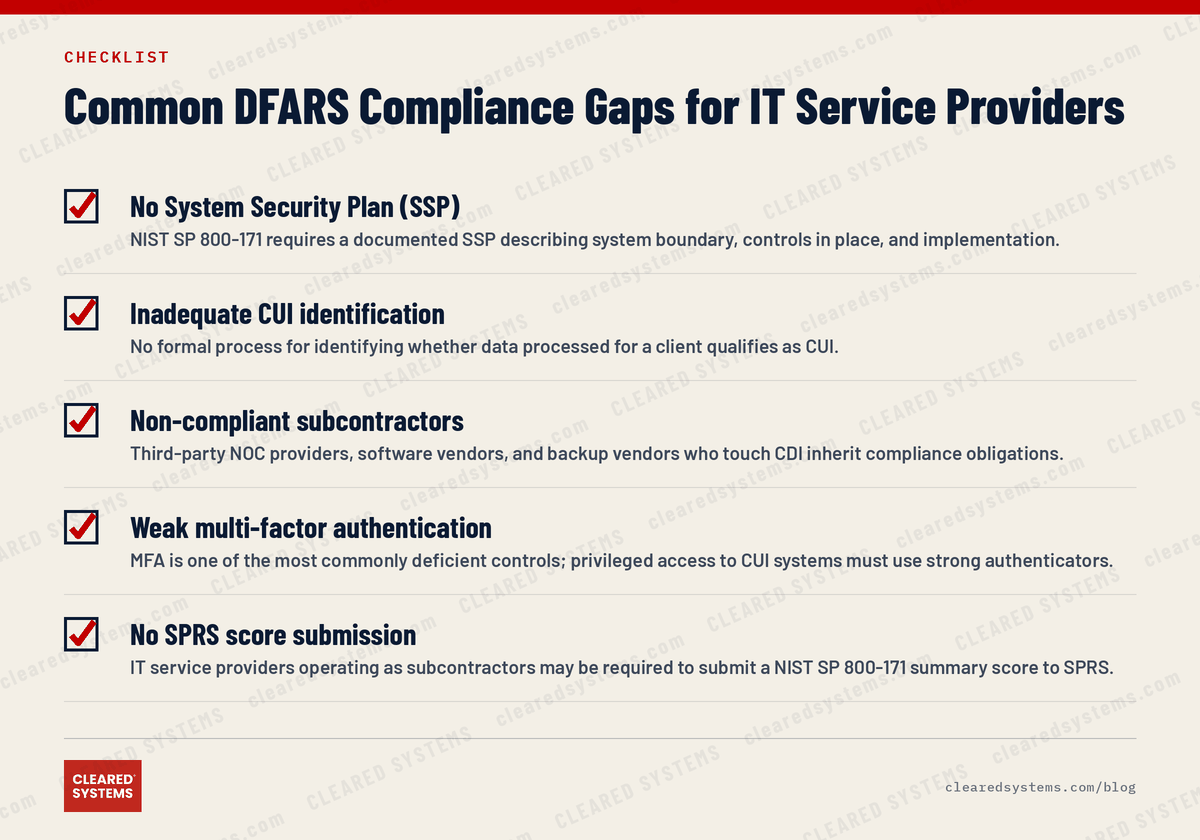
Based on our work supporting the defense industrial base, we see the following compliance gaps appear repeatedly at IT service firms entering or operating within the DIB:
- No System Security Plan (SSP): NIST SP 800-171 requires a documented SSP that describes the system boundary, the security controls in place, and how they are implemented. Many IT service providers have never produced one.
- Inadequate CUI identification: You cannot protect what you have not defined. Many IT service providers do not have a formal process for identifying whether the data they process for a client qualifies as CUI.
- Non-compliant subcontractors: IT service providers often rely on their own subcontractors—third-party NOC providers, software vendors, backup vendors—who also touch CDI. The compliance obligation flows to them as well.
- Weak multi-factor authentication: MFA is one of the most commonly deficient controls in assessments. Privileged access to any system handling CUI must be protected with strong authenticators.
- No SPRS score submission: Defense contractors are required to submit a summary score reflecting their NIST SP 800-171 implementation to the Supplier Performance Risk System (SPRS). IT service providers operating as subcontractors may have this same obligation.
For a deeper look at recurring failures, our post on the most common DFARS 252.204-7012 compliance failures and how to fix them provides a detailed breakdown.
The Relationship Between DFARS 252.204-7012 and CMMC
DFARS 252.204-7012 and the Cybersecurity Maturity Model Certification (CMMC) are related but distinct requirements. DFARS is an existing contractual clause with current enforceability. CMMC 2.0 is the evolving certification framework that the DoD is rolling out to verify compliance through third-party assessments rather than self-attestation alone.
IT service providers supporting defense contractors at CMMC Level 2 will ultimately need to demonstrate that their environments meet the same 110 NIST SP 800-171 controls that DFARS requires—but through a more rigorous, documented, and third-party-verified process. Building DFARS compliance today is not wasted effort; it is the foundation for CMMC certification. Our post on DFARS 252.204-7012 vs. CMMC 2.0 explains how the two frameworks interact.
How Cleared Systems Supports IT Service Providers
Cleared Systems works with IT service providers across the defense industrial base to build compliance programs that satisfy DFARS requirements and position organizations for CMMC certification. Our CMMC, CUI, and DFARS compliance service is specifically designed to address the technical, administrative, and documentation requirements that IT service providers face. We also offer federal risk assessments that give IT service providers a clear, documented picture of where their environments stand against NIST SP 800-171.
For organizations that need ongoing security leadership without hiring a full-time CISO, our regulatory vCISO service provides experienced oversight aligned to the specific demands of defense contracting compliance. We can also help you build or strengthen your broader compliance program so that DFARS obligations are managed systematically rather than reactively.
IT service providers serving the federal and defense sector carry real compliance obligations that require deliberate program investment. Waiting for a client to flag a gap during contract review is not a strategy—it is a liability.
Take the Next Step
If your firm provides IT services to defense contractors and you are uncertain whether your current environment satisfies DFARS 252.204-7012 compliance requirements, the time to assess is now—not after a contract award or an incident. Contact Cleared Systems to request a quote and learn how we can help you build a defensible, audit-ready compliance program that protects your contracts and your clients.