

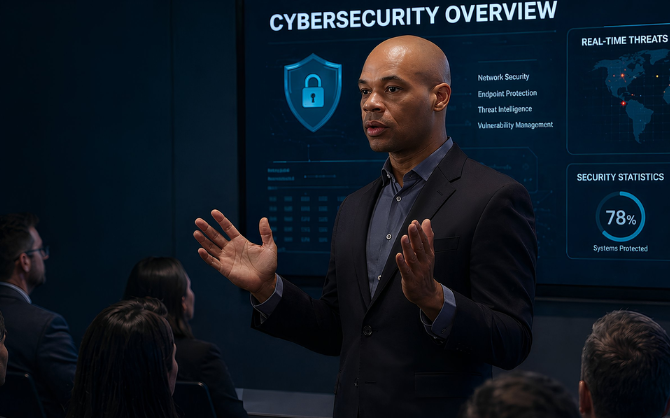
Senior compliance leadership on retainer — strategy, governance, and accountability for regulated organizations that need a CISO without the full-time headcount cost.
You need a CISO. You may not need a $400,000 headcount.
Cleared Systems' Regulatory vCISO service places senior compliance and security leadership inside your organization on a retainer basis — providing the strategic direction, governance ownership, regulatory interpretation, and executive-level accountability that a full-time CISO would, at a fraction of the cost and a fraction of the recruiting timeline. Unlike a generic vCISO offering, our practice is anchored in federal and regulated-industry compliance: CMMC, NIST 800-171 and 800-53, FedRAMP, DFARS, ITAR, HIPAA, GLBA, and the sector-specific requirements that drive real obligations for our clients.
What is a Regulatory vCISO?
A Regulatory vCISO is an experienced senior compliance and security professional who serves your organization as the equivalent of a full-time Chief Information Security Officer — responsible for security strategy, regulatory compliance ownership, governance, risk management, and executive-level accountability — but engaged on retainer rather than employed full-time.
The "Regulatory" qualifier is intentional. A generic vCISO can write a security policy. A Regulatory vCISO can interpret a DFARS 7012 clause against your contract, scope a CMMC assessment against your CUI flow, evaluate a SaaS vendor for FedRAMP equivalence, and represent your organization in front of an auditor without losing the room. The role demands a specific kind of practitioner — one who has actually built compliance programs, not just consulted on them.
This service is built for organizations that have outgrown ad-hoc compliance management but aren't yet at the point where a full-time CISO is the right call. It's also right for organizations whose compliance environment is too specialized for a general-purpose IT leader to own — defense, healthcare, financial services, education, utilities — where the regulatory specificity matters more than the org-chart title.
Why You Need This Service
The structural reasons more organizations are turning to Regulatory vCISO models:
Hiring a full-time CISO is hard, slow, and expensive. The market for senior security leaders with federal compliance depth is tight. Recruitment cycles routinely run six to nine months. Total comp for a federally-experienced CISO has crossed $400K base in many markets. Many organizations need the role filled now and can't justify the budget at full-time levels.
Regulatory burden is increasing faster than organizational maturity. CMMC, FedRAMP, HIPAA Security Rule updates, GLBA Safeguards Rule changes, state-level cyber regulations, and sector-specific requirements all keep accelerating. Most mid-sized organizations don't have anyone whose job it is to track these — until something breaks.
Compliance ownership keeps falling on the wrong roles. IT directors, CTOs, controllers, and general counsel all end up owning pieces of compliance that don't naturally belong to them. The result is gaps, conflicts of interest, and slow decision-making. A Regulatory vCISO consolidates that ownership in one accountable senior role.
Boards and customers want to see senior security accountability. Cyber insurance carriers, federal customers, prime contractors, and cyber-mature private buyers all increasingly ask "who owns security at your organization?" — and "the IT director" is no longer a satisfying answer for organizations of meaningful size.
Mid-engagement complexity demands continuous senior judgment. CMMC engagements, FedRAMP authorizations, and complex multi-framework programs all run for many months and surface decisions that need senior compliance judgment to resolve correctly. Without that role staffed, decisions get deferred, escalated, or made wrong.
What We Deliver
A Regulatory vCISO engagement is shaped to the organization, but typically includes:
- Ownership of the organization's compliance program — strategy, roadmap, and accountability
- Regular cadence with executive leadership: monthly or quarterly board-level reporting, weekly tactical sync with operating leaders
- Regulatory interpretation and decision support — what does this clause actually require? what's the right answer to this prime's questionnaire? do we need to disclose this incident?
- Vendor and third-party risk management oversight, including SaaS evaluation, contract review, and ongoing third-party assessment
- Audit and assessment leadership — preparing for, sitting in on, and responding to C3PAO assessments, FedRAMP 3PAO engagements, OIG reviews, and customer audits
- Incident response leadership during real incidents, including coordination with legal, communications, insurance, and regulators
- Policy and procedure ownership — making sure the documents reflect what the organization actually does, and that gaps are surfaced and closed
- Workforce-level security awareness program oversight
- Risk management framework execution: maintaining the risk register, prioritizing remediation, owning risk-acceptance decisions at the appropriate level
- Government and customer relationship management for compliance-related interactions
- Coverage during transitions: between full-time CISOs, during M&A activity, during major program launches
A vCISO engagement is not a fractional advisory role. It's a continuous embedded leadership role — one that takes responsibility for outcomes, not just opinions.
Frameworks and Domains We Cover
CMMC 2.0 (Levels 1, 2, and 3), NIST SP 800-171, 800-53, 800-37 (RMF), and 800-30 (risk), FedRAMP (Low, Moderate, High), StateRAMP, DFARS 252.204-7012/7019/7020/7021, ITAR and EAR programs, HIPAA Security and Privacy Rules, HITECH, GLBA Safeguards Rule, SOC 2 Type II, ISO 27001:2022, CJIS Security Policy, FISMA, NERC CIP (where applicable), the NIST Cybersecurity Framework, and Zero Trust architecture (OMB M-22-09 and related guidance).
Who This Is For
The Regulatory vCISO model is the right fit for healthcare-adjacent organizations under HIPAA, financial institutions under GLBA Safeguards and state cyber rules, SLED organizations and educational institutions, power and utility providers under NERC CIP, and small-to-mid-sized defense contractors and federal suppliers who need senior compliance leadership but aren't ready for a full-time CISO. Explore the full set of industries Cleared Systems supports to see how vCISO leadership applies in your sector.
You'll get the most from this engagement if your organization meets at least one of the following: revenue between $5M and $250M, regulatory environment that includes at least one major framework (CMMC, FedRAMP, HIPAA, GLBA, etc.), no current full-time security leadership, and a board or customer base that's asking about senior security accountability.
How We Engage
The Regulatory vCISO service is exclusively a retainer engagement. The role doesn't work on a project-scoped basis — continuous availability and accountability are the entire point. Engagement structure varies by organization size and complexity, ranging from a few hours per week of strategic and governance support up to near-full-time embedded leadership. See how Cleared Systems engages for context.
vCISO engagements are typically the umbrella under which other services run — a vCISO often initiates Compliance Program Development, oversees Federal & SLED Risk Assessments, or directs CMMC, CUI & DFARS Compliance work. The vCISO owns the executive accountability; the supporting services do the build-out and operational execution. Request a quote for a Regulatory vCISO engagement and we'll scope a structure against your organization's size, complexity, and regulatory environment.
Common Questions
How is a Regulatory vCISO different from a generic vCISO?
The depth of regulatory expertise. A generic vCISO can manage a SOC 2 program. A Regulatory vCISO can navigate the simultaneous demands of CMMC, DFARS, ITAR, and HIPAA — and represent your organization credibly in front of any of those regulators or assessors. For organizations in regulated sectors, that depth is the entire value of the engagement.
How many hours per week is a vCISO engagement?
Varies by organization. Smaller, less complex environments may need 4–10 hours per week of dedicated time plus on-demand availability for incidents and decisions. Larger or more complex environments may need 20+ hours per week of embedded leadership. We scope this in the initial conversation against the actual demands of the role.
Will the vCISO be the same person throughout the engagement?
Yes. The role is continuous and personal. You'll work with a named senior practitioner who is responsible for your organization. Cleared Systems supports the vCISO with the rest of the firm's expertise — but the vCISO is your senior accountable security leader, not a rotating consultant.
Can a vCISO handle our incident response?
Yes, and that's frequently the moment when the value of the engagement becomes most visible. The vCISO leads the response, coordinates with legal and insurance, manages regulator communications, and makes the judgment calls that have to be made fast and made right. Organizations that have lived through an incident with a vCISO usually never go back to operating without one.
What happens when our organization is ready for a full-time CISO?
We help you transition. The vCISO supports recruiting, onboards the new hire, and steps back as the full-time role becomes self-sufficient. The transition is part of how we engage — not a moment of friction.
Senior Compliance Leadership, Without the Full-Time Cost
You can't outsource accountability. But you can engage a senior practitioner who takes ownership the same way a full-time CISO would. Request a quote for a Regulatory vCISO engagement and we'll structure a retainer that gives your organization the executive-level compliance leadership it needs at a cost that makes operational sense.