
Why Documentation Comes Before Everything Else in ISO 27001 Readiness
Every week, organizations approach ISO 27001 readiness backward. They want to begin gap assessments, build control frameworks, and schedule certification audits before they have done the foundational work that makes all of that possible. The result is wasted time, repeated work, and audit findings that could have been avoided.
ISO 27001 is a documentation-intensive standard. The certification body will evaluate not just what your controls do, but whether your organization can demonstrate that those controls exist within a coherent, documented Information Security Management System. If that documentation is absent, incomplete, or inconsistent, your readiness work has no foundation to stand on.
Before your organization can meaningfully begin an ISO 27001 readiness assessment, there is a set of documents and records that must already exist or be developed in parallel. This post identifies what those documents are, why each one matters, and what happens when organizations try to skip them.
The Core Documentation Categories You Must Address
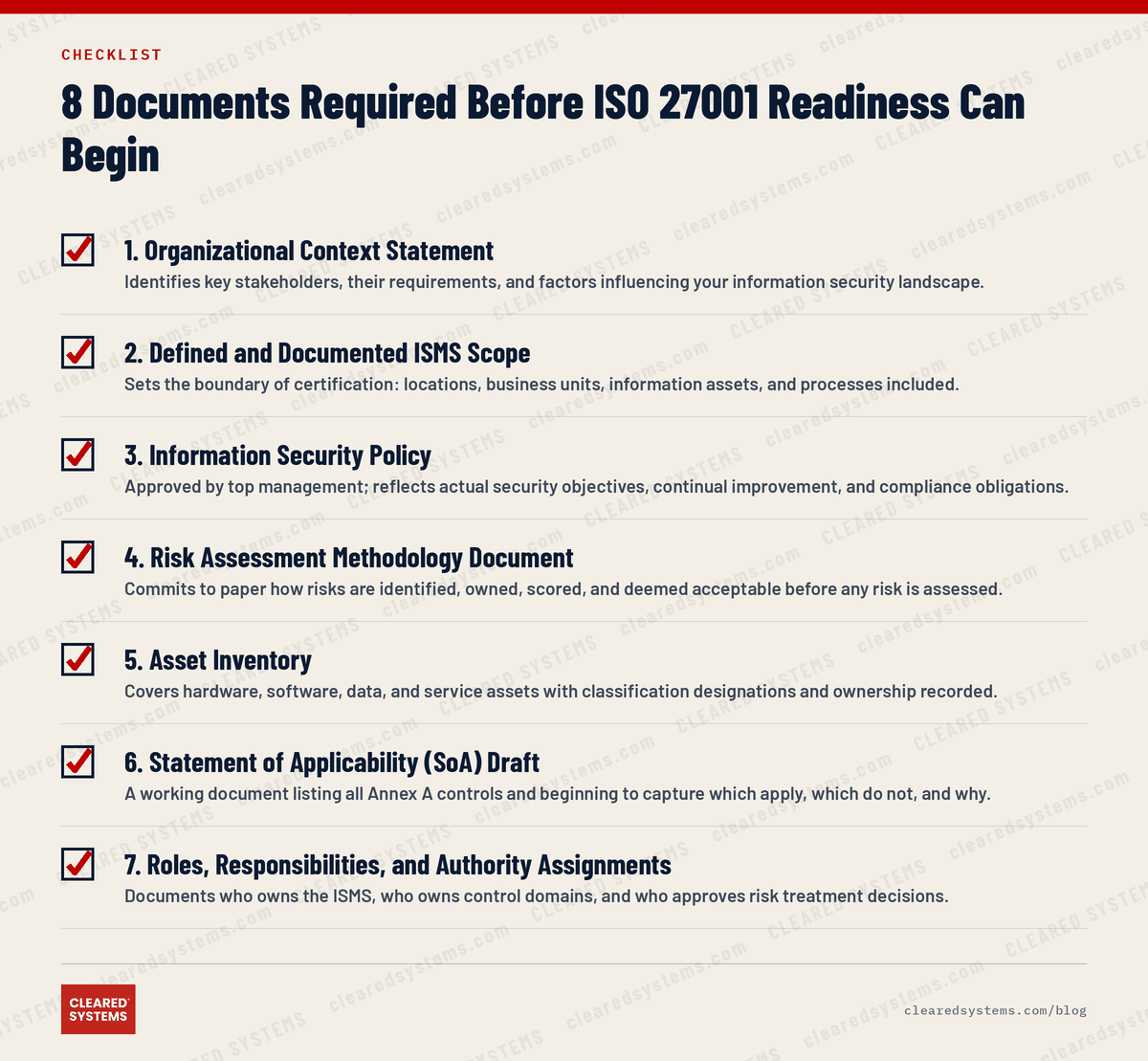
1. An Organizational Context Statement
ISO 27001 Clause 4 requires that your organization understand its context—internal and external issues that affect its ability to achieve the intended outcomes of the ISMS. This is not a vague philosophical exercise. You need a written document that identifies your key stakeholders, their relevant requirements, and the factors that influence your information security landscape.
For defense contractors and federal vendors, this includes regulatory obligations, contractual requirements from prime contractors, and the expectations of federal agencies. Organizations that serve the federal and defense sector typically have a more complex stakeholder environment than their commercial peers, and that complexity must be captured in writing before the ISMS can be scoped properly.
2. A Defined and Documented ISMS Scope
The scope document is the boundary of your ISO 27001 certification. It defines which locations, business units, information assets, and processes fall inside the ISMS. Without a finalized scope, every downstream decision—from risk assessment to control selection to Statement of Applicability—is premature.
Scope decisions have strategic implications. A scope that is too narrow may not satisfy customer or contractual requirements. A scope that is too broad can make certification unmanageable. Getting this right on paper before readiness activities begin saves significant rework later.
3. An Information Security Policy
ISO 27001 Clause 5.2 requires a documented information security policy that is approved by top management, communicated to relevant parties, and available to interested parties. This is not a policy template downloaded from the internet and lightly edited. It must reflect your organization's actual security objectives, its commitment to continual improvement, and its compliance obligations.
Many organizations that have been operating under informal security practices struggle here. If your security posture exists primarily in tribal knowledge and email threads rather than written policy, that gap must be closed before readiness begins. Compliance program development support can help organizations build this policy infrastructure from the ground up.
4. A Risk Assessment Methodology Document
ISO 27001 requires a documented risk assessment process—one that produces consistent, comparable, and reproducible results. Before you assess a single risk, your organization must have committed to paper how it will identify risks, who owns them, how likelihood and impact will be scored, and what criteria will be used to decide whether a risk is acceptable.
This methodology document is a prerequisite. Without it, the risk assessment that follows is not auditable. Certification bodies will ask to see this methodology before they evaluate your risk register. Organizations that have not done formal risk work before will benefit from professional risk assessment support to structure this methodology correctly from the start.
5. An Asset Inventory
You cannot assess or manage risk to information assets you have not identified. ISO 27001 Annex A includes asset management controls, but more fundamentally, every other part of the ISMS depends on knowing what information your organization holds, where it lives, who is responsible for it, and how it is classified.
This inventory must be documented. It should cover hardware assets, software assets, data assets, and service assets. For organizations handling sensitive government information, it must also capture data classification designations. Without this inventory, the risk assessment is incomplete, the Statement of Applicability cannot be properly justified, and your controls cannot be mapped to what they are supposed to protect.
6. A Statement of Applicability (SoA) Draft
Strictly speaking, the Statement of Applicability is produced during readiness, not before it. But organizations that have never reviewed ISO 27001 Annex A controls often underestimate the work involved and begin readiness activities without understanding the scope of control decisions ahead of them. Having at least a preliminary SoA framework—a working document that lists all Annex A controls and begins to capture which apply, which do not, and why—gives your readiness effort clear direction.
Your ISO 27001 compliance effort will produce a final, management-approved SoA, but starting with a rough draft prevents readiness teams from treating control selection as an afterthought.
7. Roles, Responsibilities, and Authority Assignments
Clause 5.3 of ISO 27001 requires that top management assign and communicate roles, responsibilities, and authorities within the ISMS. This must be documented. The certification body will ask who owns the ISMS, who is responsible for specific control domains, and who has the authority to approve risk treatment decisions.
In many organizations, especially those without a full-time CISO, these assignments are unclear or contested. Organizations in this position often benefit from regulatory vCISO services, which provide structured security leadership and ensure that ISMS ownership is properly assigned and documented before readiness begins.
8. Existing Policies, Procedures, and Records
ISO 27001 readiness is not built in a vacuum. Your organization almost certainly has existing security-related documentation—acceptable use policies, password policies, incident response procedures, vendor agreements, training records, audit logs. These must be inventoried and evaluated before readiness begins, because they will either become inputs to your ISMS or will need to be revised or replaced.
Organizations that discover mid-readiness that their existing policies contradict each other, have not been reviewed in years, or exist only as unapproved drafts face significant delays. A documentation inventory conducted before readiness begins prevents this problem.
Common Documentation Gaps That Delay ISO 27001 Readiness
- No formal risk methodology: Risk assessments conducted without a documented methodology are not repeatable and will not satisfy certification requirements.
- Incomplete asset inventory: Organizations frequently undercount their information assets, particularly in cloud environments and across subsidiary entities.
- Unsigned or unapproved policies: Policies that have not been formally approved by top management do not satisfy ISO 27001's management commitment requirements.
- Missing or unclear ISMS scope: An undefined scope makes every downstream activity provisional and subject to revision.
- No documented roles and responsibilities: ISMS ownership gaps are among the most common findings during certification audits.
What a Gap Assessment Will Tell You—But Only If You Have the Foundation First
A formal ISO 27001 gap assessment evaluates your current state against the requirements of the standard. It is an essential step in readiness. But a gap assessment conducted before the foundational documentation is in place produces results against an incomplete baseline. You will get a report that flags the documentation gaps alongside technical control gaps, and you will not know which remediation work to do first.
When the documentation foundation is solid before the gap assessment begins, the assessment findings are more precise, the remediation roadmap is more actionable, and the path to certification is significantly shorter.
Organizations pursuing ISO 27001 for the first time—especially those in the defense industrial base or regulated healthcare sector—benefit from outside expertise during this pre-readiness phase. IT compliance services that include ISMS implementation support help organizations build the documentation architecture correctly before formal readiness activities begin.
The Management Commitment Documents That Often Get Overlooked
ISO 27001 places significant emphasis on leadership engagement. Beyond the information security policy, top management must demonstrate commitment through a set of documented actions:
- Formal approval of the ISMS scope and policy
- Documented allocation of ISMS resources
- Communication of information security objectives to the organization
- Evidence that management reviews the ISMS at planned intervals
These are not checkbox items. Certification auditors will interview leadership and look for evidence that management commitment is real, documented, and ongoing. Organizations that treat ISO 27001 as an IT project rather than a management system frequently fail at this stage.
Start Documentation Before You Start Readiness
The organizations that move through ISO 27001 readiness most efficiently are the ones that arrive at the starting line with their documentation house in order. That means a defined scope, an approved information security policy, a documented risk methodology, an asset inventory, clearly assigned ISMS roles, and an inventory of existing security documentation.
None of this happens by accident. It requires intentional effort, often with external support, before formal readiness begins. The payoff is a readiness process that moves in a straight line toward certification rather than cycling back to fix foundational problems.
If your organization is preparing for ISO 27001 and you are not sure where your documentation stands, Cleared Systems can help you assess your current state and build the foundation you need. Visit our request a quote page to start a conversation about your ISO 27001 readiness goals and how we support organizations through every phase of the process.