
Why the Gap Assessment Report Is Your Most Important ISO 27001 Document
Organizations pursuing ISO 27001 certification often invest significant effort in the gap assessment itself, then set the final report aside once it arrives. That is a costly mistake. The gap assessment report is not a formality — it is a prioritized blueprint for everything your organization must accomplish before an accredited certification body can issue a certificate. Every section of that document carries operational weight, and compliance managers who understand what each section means will move faster, spend smarter, and face fewer surprises during the formal audit.
This post walks through the standard structure of an ISO 27001 gap assessment report, explains what each section is actually telling you, and lays out the practical actions you should take after the report lands on your desk.
Section 1: Executive Summary
The executive summary distills the assessment into a high-level picture intended for leadership, not just your IT or compliance team. It typically identifies your organization's overall maturity level against ISO 27001:2022, the number of controls assessed, the proportion found fully implemented versus partially implemented versus missing, and the assessor's overall certification readiness opinion.
What to do with it: Use this section to brief your executive team and board. The maturity rating and readiness opinion should inform budget conversations immediately. If the summary indicates significant gaps across multiple control domains, leadership needs to understand that remediation is a multi-month program, not a checklist exercise. If you have not yet seen our related post on ISO 27001 compliance and data protection risk management, it provides useful context for framing these conversations.
Section 2: Scope and Methodology
This section defines what was assessed and how. A well-written scope section identifies the information assets, systems, locations, business processes, and organizational units included in the assessment. The methodology section describes how evidence was gathered — through document review, staff interviews, technical testing, observation, or some combination of these approaches.
What to do with it: Read this section carefully to confirm that the scope aligns with the Information Security Management System (ISMS) boundary you intend to certify. If the gap assessment scope is narrower than your planned certification scope, you have uncovered areas that were not evaluated and may carry hidden risk. Conversely, if the scope is broader than necessary, you may be investing remediation resources in areas outside your intended boundary. Scope misalignment at this stage is far cheaper to correct than scope misalignment discovered during a formal audit.
Section 3: Current State Findings by Control Domain
This is the technical core of the report and typically the longest section. ISO 27001:2022 Annex A contains 93 controls organized across four themes: Organizational Controls, People Controls, Physical Controls, and Technological Controls. Your gap assessment report maps each control — or at minimum each applicable control — against one of several maturity ratings, commonly expressed as:
- Implemented: Evidence confirms the control is fully operational and effective.
- Partially Implemented: Some elements of the control exist, but gaps remain in documentation, consistency, or coverage.
- Not Implemented: The control does not exist or no verifiable evidence was found.
- Not Applicable: The control has been formally excluded with justification documented in the Statement of Applicability.
Each finding should include a description of the gap, the risk it introduces, and the control reference from the standard. Quality reports also note whether the gap is a documentation failure — meaning the practice exists but is not written down — or an operational failure, meaning the practice does not exist at all. This distinction drives very different remediation timelines and costs.
What to do with it: Do not treat all findings as equal. Sort gaps by theme and severity. Documentation gaps are usually faster and less expensive to close. Operational gaps — missing access reviews, absent vulnerability management processes, no supplier security assessments — require process design, tooling, and behavioral change. Our IT compliance services team regularly helps organizations prioritize and sequence remediation across exactly these types of findings.
Section 4: Risk Assessment Alignment
ISO 27001 is fundamentally a risk-based standard. Your gap assessment report should comment on whether your organization has an existing risk assessment process and, if so, whether that process meets the requirements of Clause 6.1. This section often highlights gaps between how your organization currently identifies and treats risk and what the standard actually requires.
What to do with it: If your risk assessment process is immature or absent, remediation here is non-negotiable. The certification body will evaluate your risk assessment documentation directly. Organizations without a defensible risk treatment plan cannot achieve ISO 27001 certification regardless of how well individual technical controls are implemented. This is an area where working with a regulatory vCISO can accelerate program design significantly.
Section 5: Statement of Applicability Gap
The Statement of Applicability (SoA) is a required ISO 27001 document that lists all Annex A controls, identifies which are applicable and which are excluded, provides justification for exclusions, and documents the implementation status of each included control. Many organizations entering their first gap assessment do not have an SoA at all.
What to do with it: If your SoA is missing or incomplete, drafting it is an early remediation priority. The SoA is not just a certification deliverable — it is a living management tool. Treat gap assessment findings in this section as inputs to your SoA drafting effort. Controls marked Not Implemented in the gap report should appear as not yet implemented in your SoA, with a target implementation date linked to your remediation roadmap.
Section 6: Prioritized Remediation Roadmap
A strong gap assessment report concludes with a prioritized list of remediation actions organized by urgency, effort, and risk impact. Some reports assign these to phases — immediate, short-term, and long-term — while others present them as a risk-ranked backlog.
What to do with it: This section should become the foundation of your internal project plan. Assign ownership, establish milestones, and integrate this roadmap into your compliance program governance. Organizations with a formal compliance program development engagement in place will find it easier to absorb and execute the roadmap because governance structures, escalation paths, and resource commitments are already defined.
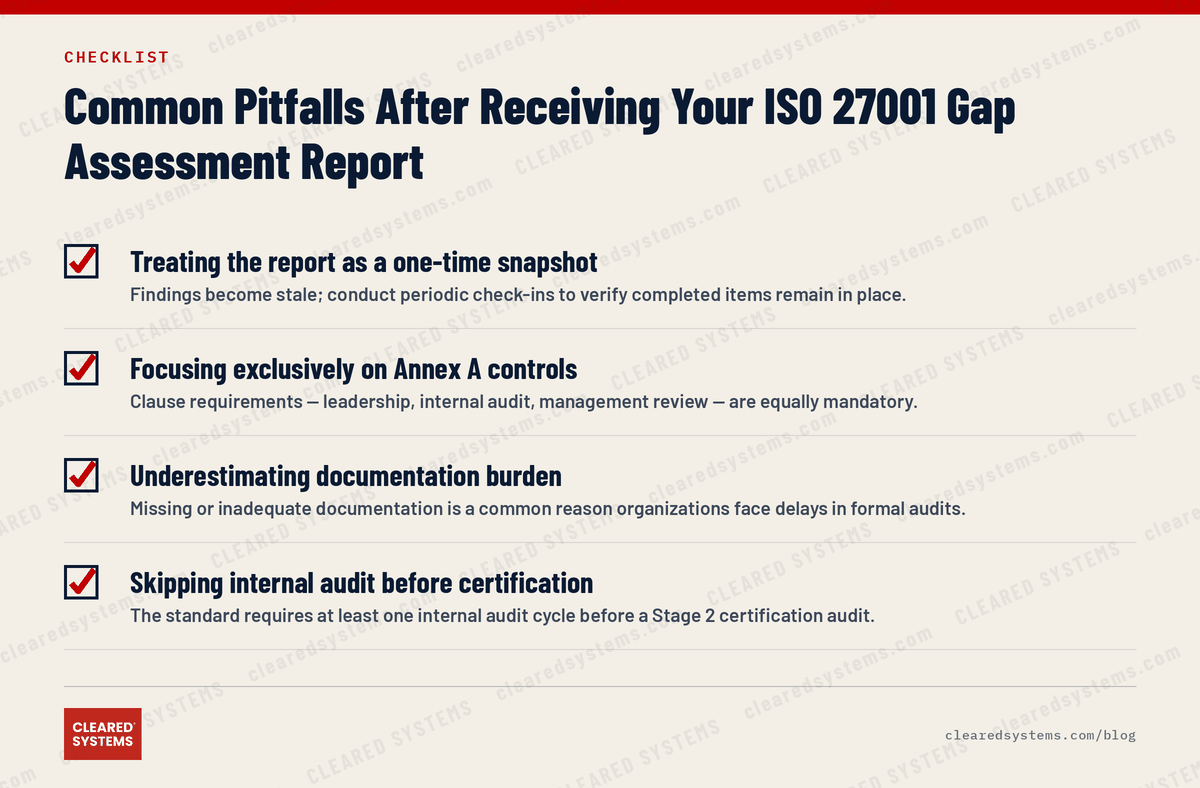
Common Pitfalls After Receiving the Report
Having worked through numerous ISO 27001 engagements, I see the same mistakes repeated after the gap assessment report is delivered:
- Treating the report as a one-time snapshot. Gap assessment findings become stale. If remediation takes twelve months, you need periodic check-ins to verify that completed items remain in place and that new gaps have not emerged.
- Focusing exclusively on Annex A controls. Annex A is only part of the standard. Clause requirements — covering leadership commitment, internal audit, management review, and continual improvement — are equally mandatory and frequently underdeveloped at organizations entering certification for the first time.
- Underestimating documentation burden. ISO 27001 requires specific documented information. Missing or inadequate documentation is one of the most common reasons organizations experience delays during formal audits. Our post on what to do with ISO 27001 gap assessment results goes deeper on structuring your documentation remediation effort.
- Skipping internal audit before certification. The standard requires at least one internal audit cycle before a Stage 2 certification audit. Organizations that rush to certification without conducting a meaningful internal audit often discover material nonconformities during the formal assessment — nonconformities that could have been corrected with time to spare.
How the Gap Assessment Fits Into the Broader ISO 27001 Journey
The gap assessment is the starting line, not the finish line. After remediating findings and building your ISMS documentation, your organization will typically undergo a Stage 1 audit — a document review by the certification body — followed by a Stage 2 audit, which is a full on-site or remote assessment against the standard. Surveillance audits occur annually, and a full recertification audit happens every three years.
Organizations in regulated industries — particularly those in federal and defense contracting — often pursue ISO 27001 alongside frameworks such as CMMC, NIST SP 800-171, or DFARS. Coordinating remediation across multiple frameworks requires careful scoping to avoid duplicating effort and to ensure that evidence collected for one framework satisfies requirements in another. Our federal and SLED risk assessment services are specifically designed to integrate with multi-framework compliance programs.
Take the Next Step
If your organization has completed an ISO 27001 gap assessment and is ready to move from findings to remediation — or if you have not yet conducted a gap assessment and need to understand where you stand before committing to certification — Cleared Systems can help. Request a quote to speak with our team about how we support organizations through every phase of the ISO 27001 compliance lifecycle, from initial gap analysis through certification readiness and beyond.