
Why DFARS 252.204-7012 Compliance Failures Keep Happening
Defense contractors have been living with DFARS 252.204-7012 since 2015, yet audit findings and contract disputes tied to this clause continue to surface at an alarming rate. After years of working alongside prime contractors, subcontractors, and their IT teams, the pattern is clear: most failures are not the result of ignorance. They are the result of underestimating what full compliance actually requires and overestimating what a quick self-assessment can reveal.
This post identifies the failures we see most consistently across the defense industrial base and gives you a practical path to close each gap. For a broader look at what the clause demands from start to finish, our existing resource on exactly what DFARS 252.204-7012 requires of contractors is a useful starting point.
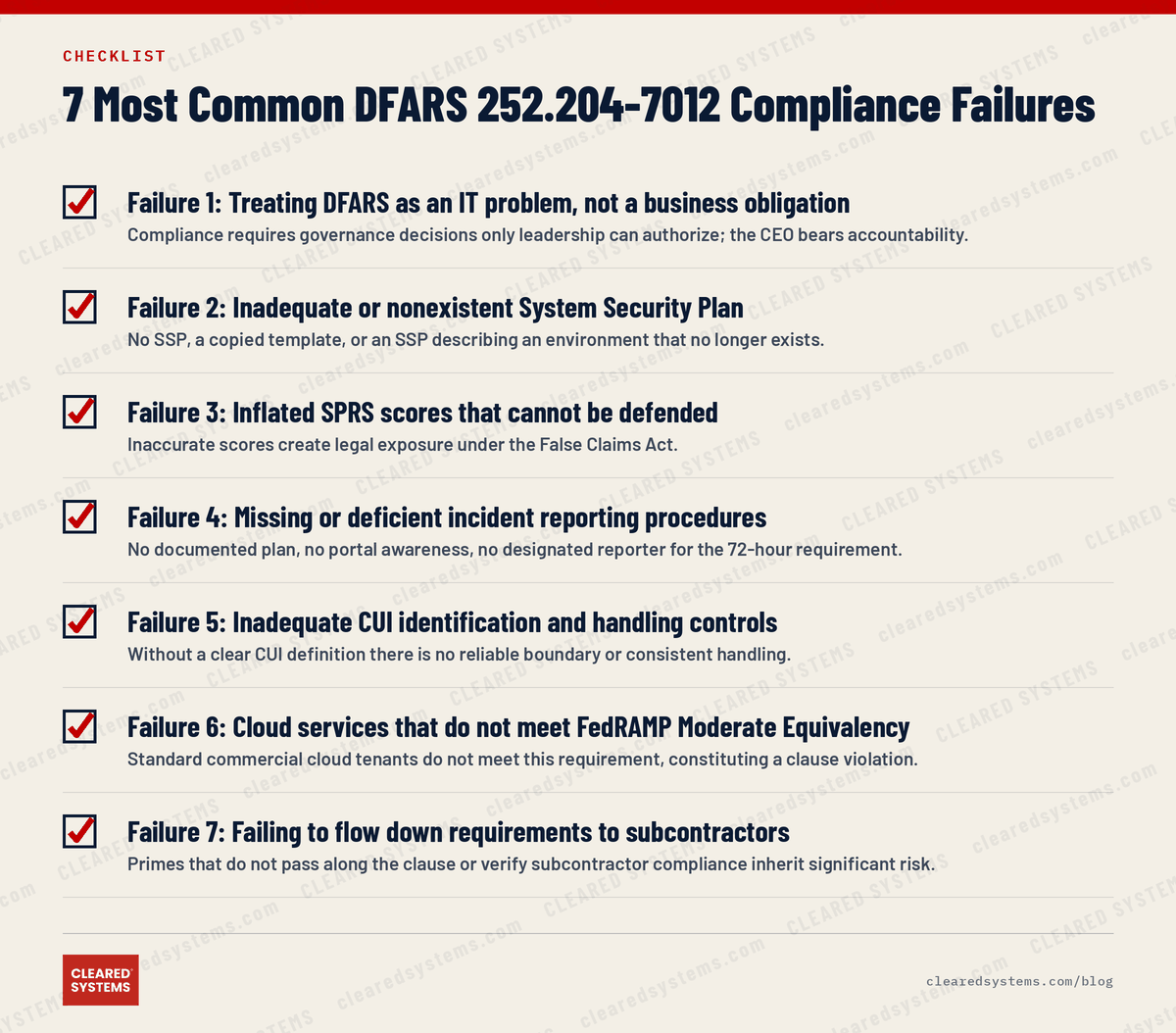
Failure 1: Treating DFARS as an IT Problem, Not a Business Obligation
The most foundational mistake executives and program managers make is delegating DFARS 252.204-7012 compliance entirely to IT staff. The clause is a contract obligation. When a company accepts a DoD contract containing this clause, the CEO and leadership team bear accountability for what happens to Covered Defense Information on that company's systems.
Compliance requires governance decisions that only leadership can authorize: scope of the system boundary, budget for remediation, acceptable risk posture, and the authorization of the System Security Plan. When those decisions are deferred indefinitely, the SSP becomes a fiction document that IT wrote and nobody owns.
How to fix it: Assign executive ownership of the compliance program. Conduct a quarterly review of your SPRS score and open POA&M items with participation from leadership, not just the IT team.
Failure 2: An Inadequate or Nonexistent System Security Plan
DFARS 252.204-7012 requires contractors to implement NIST SP 800-171 and to maintain a System Security Plan documenting how each of the 110 controls is addressed. What we routinely find instead is one of three things: no SSP at all, an SSP copied from a template without customization, or an SSP that describes an environment that no longer exists.
A generic template does not constitute a compliant SSP. The document must accurately describe your actual systems, your actual network architecture, the actual people who access CUI, and the actual controls in place. Assessors and contracting officers treat a superficial SSP as evidence that your controls are equally superficial.
How to fix it: Conduct a thorough CUI boundary assessment before drafting or revising your SSP. Map every system that touches Covered Defense Information. The SSP must be a living document, reviewed and updated whenever the environment changes. Our post on SSP and POA&M as critical components of a strong security program goes deeper on what these documents must contain.
Failure 3: Inflated SPRS Scores That Cannot Be Defended
Contractors are required to self-assess their NIST SP 800-171 implementation and submit a score to the Supplier Performance Risk System. The methodology begins at 110 points, with deductions for each unimplemented or partially implemented control. What we see far too often are scores in the 80s and 90s that do not reflect reality.
Submitting an inaccurate SPRS score is not just a compliance gap. Under the False Claims Act, it creates personal and corporate legal exposure. The Department of Justice has already pursued contractors for knowingly misrepresenting their cybersecurity posture to obtain federal contracts.
How to fix it: Conduct or commission an objective, evidence-based self-assessment against all 110 NIST SP 800-171 controls. Document your methodology. Where controls are not met, reflect that in your score and open corresponding POA&M items. Our analysis of SPRS cybersecurity assessments for defense contractors explains how the scoring process works and where contractors most commonly go wrong.
Failure 4: Missing or Deficient Incident Reporting Procedures
DFARS 252.204-7012 imposes a 72-hour reporting requirement. When a cyber incident affects a covered contractor information system, you must report it to DoD through the DIBNet portal within 72 hours of discovery. That window closes faster than most organizations realize, particularly over a weekend or holiday.
Common failures here include no documented incident response plan, an incident response plan that does not address DoD reporting specifically, teams that are unaware of the portal or the timeline, and no designated individual authorized to submit the report. Any one of these gaps can result in a missed reporting obligation.
How to fix it: Build a DFARS-specific incident response procedure that identifies the reporting trigger, designates who submits the report, and rehearses the 72-hour process. Integrate this with your broader incident response plan. Preserve images of all compromised systems as required. Test your plan annually at minimum.
Failure 5: Inadequate CUI Identification and Handling Controls
Many contractors struggle to define, with precision, what qualifies as Covered Defense Information in their environment. Without that definition, there is no reliable boundary, no consistent handling, and no defensible access control policy. Employees share files through unapproved collaboration tools, store data on personal devices, and email technical data without encryption because nobody has told them what the rules are or why they apply.
How to fix it: Conduct a formal CUI identification exercise. Train employees on what CUI looks like in your specific contracts and what handling requirements apply. Implement technical controls—encryption in transit and at rest, access controls tied to need-to-know, and audit logging—that apply consistently across every location where CUI resides. For a plain-language breakdown of CUI basics, see our posts on what CUI Basic means and what CUI Specified means.
Failure 6: Cloud Services That Do Not Meet FedRAMP Moderate Equivalency
DFARS 252.204-7012 requires that any cloud service used to process, store, or transmit Covered Defense Information meet security requirements equivalent to FedRAMP Moderate. Standard commercial cloud tenants—including standard Microsoft 365 and standard Google Workspace—do not meet this requirement. Contractors routinely process CUI in commercial cloud environments, unaware that this constitutes a clause violation regardless of how strong their other controls may be.
The DoD has clarified what FedRAMP Moderate Equivalency means and how it must be documented. Using a noncompliant cloud environment is a gap that contracting officers and auditors will catch.
How to fix it: Audit every cloud service your organization uses for handling CUI. Confirm each service's FedRAMP authorization status. For Microsoft environments, understand whether your organization needs to migrate to GCC High and what that migration entails. Our resource on which Microsoft cloud version meets DFARS, NIST, and ITAR security requirements provides a practical comparison.
Failure 7: Failing to Flow Down Requirements to Subcontractors
Prime contractors are required to flow DFARS 252.204-7012 down to any subcontractor that will process, store, or transmit Covered Defense Information. Primes that accept this obligation and then subcontract portions of the work without passing along the clause—or without verifying that subcontractors comply—inherit significant risk. If a subcontractor suffers a breach involving CDI and had no DFARS obligation in place, the prime contractor faces serious contractual and legal exposure.
How to fix it: Audit your subcontract templates. Confirm that DFARS 252.204-7012 is included wherever applicable. Request SPRS scores and SSP summaries from subcontractors who handle CDI as part of your vendor management process.
Building a Program That Holds Up
Closing these gaps requires more than a checklist. It requires a structured compliance program with documented policies, trained personnel, tested controls, and ongoing monitoring. Many contractors find that the complexity of maintaining NIST SP 800-171 compliance, managing an accurate SPRS score, and staying current with evolving DoD guidance requires dedicated expertise they do not have in house.
Cleared Systems works with federal and defense contractors to build and sustain DFARS 252.204-7012 compliance programs that are accurate, defensible, and audit-ready. Our CMMC, CUI, and DFARS compliance services address the full scope of requirements—from CUI boundary definition and SSP development to SPRS scoring, POA&M management, and incident response preparation. Where organizations need ongoing security leadership to sustain their program, our Regulatory vCISO services provide the executive-level oversight that keeps compliance from slipping between contract cycles.
If your organization is also working toward CMMC certification, our post on how DFARS 252.204-7012 and CMMC 2.0 overlap and differ will help you understand how these two frameworks interact and how to pursue both efficiently.
Take the Next Step
If any of the failures described in this post sound familiar, the time to act is before your next contract award or audit—not after. Request a quote from Cleared Systems today to discuss where your DFARS 252.204-7012 compliance program stands and what it will take to get it where it needs to be. Our team brings practical, defense-sector experience to every engagement and will give you an honest assessment of what your program actually requires.