
Why Multi-Entity Organizations Face Unique CMMC Microsoft 365 Setup Challenges
Most CMMC guidance assumes a single legal entity with a single Microsoft 365 tenant and a clearly defined boundary around Controlled Unclassified Information (CUI). That assumption breaks down quickly for holding companies, joint ventures, prime contractors with captive subsidiaries, and organizations that have grown through acquisition. When two or more legal entities share infrastructure, billing relationships, or even just a common IT team, the CMMC Microsoft 365 setup question becomes substantially more complicated.
I see this scenario regularly at Cleared Systems. A parent company acquires a defense-focused subsidiary. Both entities process CUI. The IT team manages a single Microsoft 365 tenant because consolidation looked efficient at the time. Now, with CMMC Level 2 certifications required for contracts across both entities, the compliance boundary questions are piling up faster than the technical ones. This post addresses the structural decisions your organization needs to make before you configure a single setting.
Understanding the CMMC Assessment Boundary in a Shared Tenant
The CMMC assessment boundary is defined around the systems, users, and data that touch CUI. In a Microsoft 365 environment, that boundary is not automatically coextensive with your tenant. It is defined by your System Security Plan (SSP) and must be defensible to a C3PAO assessor.
When multiple legal entities share a single GCC High tenant, you face a fundamental question: does the assessor evaluate the entire tenant, or only the portion attributable to the entity seeking certification? The practical answer is that the assessment boundary follows CUI flow. If employees from Entity A can access SharePoint sites or Teams channels where Entity B stores CUI, that access path is in scope regardless of organizational charts.
This is why understanding what GCC High actually provides is a prerequisite to any multi-entity planning conversation. GCC High satisfies the data residency and sovereignty requirements that underpin CMMC Level 2, but it does not automatically create compliant internal boundaries between entities sharing the same tenant.
Three Structural Approaches for Multi-Entity Organizations
Option 1: Separate Tenants for Each Entity
The cleanest approach from a compliance boundary perspective is to provision separate GCC High tenants for each legal entity that processes CUI. Each entity maintains its own SSP, its own access controls, and its own assessment scope. There is no ambiguity about where one entity's CUI environment ends and another begins.
The tradeoff is operational overhead. Cross-tenant collaboration requires federated identity or guest access configurations, both of which must be carefully governed to prevent CUI from flowing across the boundary uncontrolled. Licensing costs also increase because pooled licensing agreements do not carry over between tenants.
For organizations where entities operate largely independently and have different prime contractor relationships, separate tenants are almost always the right answer. The case study of unifying two tenants after a full acquisition illustrates exactly the kind of complexity that emerges when organizations try to merge what should stay separate.
Option 2: Single Tenant with Defined CUI Enclaves
A single GCC High tenant can support multiple entities if the technical architecture creates enforceable boundaries between them. This typically means using separate Microsoft Entra ID administrative units or separate Azure AD B2B configurations, combined with strict conditional access policies, sensitivity label scopes, and SharePoint site access controls that segment CUI by entity.
Under this model, the SSP for each entity describes its enclave within the shared tenant. The challenge is demonstrating to an assessor that controls are genuinely enforced and that cross-entity data flows are auditable. Misconfigured sharing settings, overly permissive guest access, or Teams channels that span both entities can collapse the boundary in ways that are not immediately visible.
Properly implemented, this approach can work. It requires disciplined configuration management and a commitment to treating compliance boundaries as first-class architectural requirements rather than documentation exercises. Our guidance on setting up Microsoft 365 for CMMC Level 2 compliance provides a starting framework for the technical controls involved.
Option 3: Hybrid Architecture with a Shared Services Tenant
Some multi-entity organizations use a commercial Microsoft 365 tenant for non-CUI collaboration and a separate GCC High tenant that contains only the systems and users that touch CUI. The CUI tenant may serve multiple entities, but its scope is narrow enough that the assessment boundary is manageable.
This approach requires strict controls to prevent CUI from migrating from the GCC High environment to the commercial environment, whether through email forwarding, file sync, or manual user behavior. Data Loss Prevention policies in Microsoft Purview are a critical control in this architecture. For background on how DLP functions in this context, see our post on understanding Data Loss Prevention.
Key Configuration Requirements Regardless of Architecture
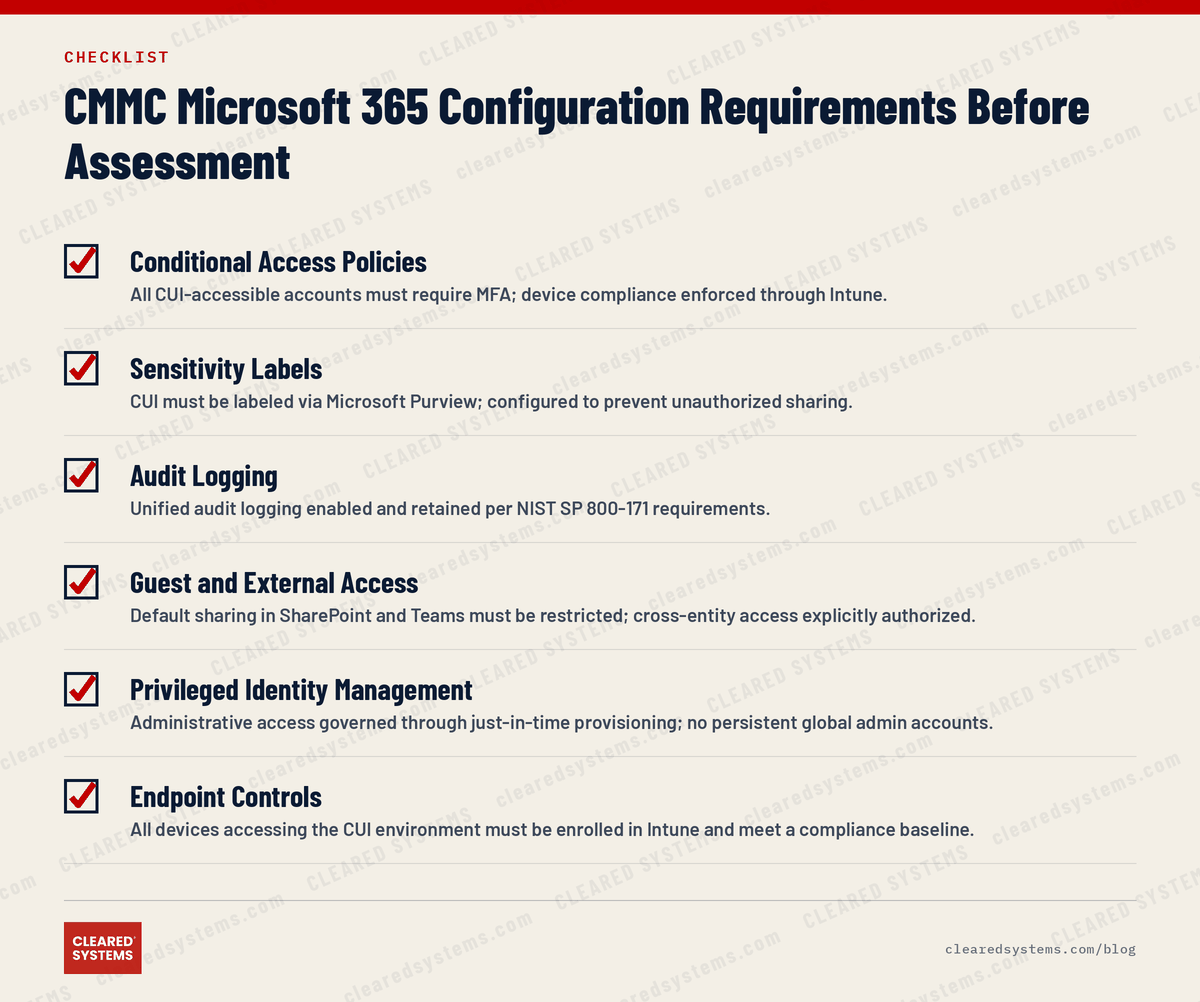
Whichever structural approach your organization selects, certain Microsoft 365 configuration requirements apply uniformly to any CMMC-compliant environment. Compliance managers should verify each of the following before an assessment:
- Conditional Access Policies: All CUI-accessible accounts must require multi-factor authentication. Device compliance requirements should be enforced through Microsoft Intune before granting access to CUI-containing resources.
- Sensitivity Labels: CUI must be labeled using Microsoft Purview Information Protection. Labels should be configured to prevent unauthorized sharing outside the defined boundary and to apply encryption where appropriate.
- Audit Logging: Unified audit logging must be enabled and retained in accordance with NIST SP 800-171 requirements. Audit logs should cover mailbox access, file access, sharing events, and administrative changes.
- Guest and External Access: Default sharing settings in SharePoint and Teams must be restricted. Any cross-entity or external collaboration must be explicitly authorized and scoped to prevent CUI exposure.
- Privileged Identity Management: Administrative access to CUI-containing environments should be governed through just-in-time provisioning. Persistent global administrator accounts are a consistent finding in CMMC assessments.
- Endpoint Controls: Devices accessing the CUI environment must be enrolled in Intune and must meet a defined compliance baseline. This applies to devices owned by all entities sharing the environment.
The CMMC Microsoft 365 setup checklist covers the specific settings your security engineers should verify before go-live.
Documenting Multi-Entity Boundaries in Your SSP
Documentation is where multi-entity CMMC environments most often fail. Each entity seeking certification needs an SSP that accurately describes its authorization boundary, the systems within scope, and the controls in place. When those entities share infrastructure, the SSPs must collectively account for every system component without creating gaps or contradictions.
Common documentation failures in shared tenant environments include:
- SSPs that describe controls as if the entity has exclusive administrative authority over the tenant, when in fact a shared IT team manages the environment across entities
- Boundary diagrams that show clean separation between entities but do not account for shared distribution lists, Teams channels, or SharePoint hubs that span both
- Control responsibility matrices that assign ownership to roles that do not exist within the assessed entity
- Missing interconnection agreements or memoranda of understanding between entities sharing infrastructure
Assessors reviewing a multi-entity environment will look for evidence that the documented controls are actually implemented and that the described boundary is technically enforced. Assertions in an SSP that are contradicted by the configuration of the tenant will generate findings.
Governance Considerations for Shared Administrative Access
One of the most practically difficult aspects of a multi-entity shared tenant is administrative governance. If a single IT team manages the GCC High environment for two entities, every administrative action taken in that environment potentially touches the compliance posture of both. This creates accountability questions that must be resolved before an assessment.
Organizations should establish written agreements between entities that define the scope of shared administrative services, the security requirements that the shared IT function must meet, and the process for handling security incidents that affect one entity but not the other. These agreements are analogous to the interconnection security agreements required under FISMA and serve a similar purpose in CMMC assessments.
For organizations that lack in-house security leadership to govern these arrangements, a Regulatory vCISO engagement can provide the ongoing oversight and documentation discipline that multi-entity environments require.
Planning Your CMMC Microsoft 365 Setup Before You Configure
The decisions described in this post are architectural, not technical. They must be made by compliance managers and executives before IT begins configuring conditional access policies or deploying sensitivity labels. Organizations that begin with configuration and try to retrofit the boundary decisions afterward consistently produce assessment-ready environments that are not actually assessment-ready.
A structured gap assessment that maps your current Microsoft 365 environment against the CMMC requirements, accounts for multi-entity complexity, and produces a prioritized remediation roadmap is the right starting point. Our CMMC, CUI and DFARS compliance services are designed to support exactly that process, from initial boundary definition through assessment preparation.
For organizations evaluating whether their current GCC High configuration actually meets CMMC requirements, our analysis of whether GCC High works for CMMC 2.0 provides useful context on what the platform provides and what your organization must still implement.
Take the Next Step
Multi-entity CMMC Microsoft 365 setup challenges are solvable, but they require deliberate planning, accurate documentation, and configuration discipline that goes well beyond a standard commercial Microsoft 365 deployment. If your organization is navigating shared tenants, acquisition-driven complexity, or joint venture structures in advance of a CMMC assessment, Cleared Systems can help you define your boundaries, close your gaps, and document your environment in a way that holds up under scrutiny. Request a quote to start the conversation with our compliance team.