
Why Executives Are the Most Valuable Target in Your Organization
Threat actors do not break down the front door when they can walk through the executive suite. CEOs, CFOs, general counsel, and program managers at defense contractors and federal vendors carry something more valuable than any server on your network: authority, access, and trust. When an adversary compromises or impersonates a senior leader, they do not need a vulnerability in your firewall. They already have one in your organizational chart.
The uncomfortable reality is that most executives in regulated industries are significantly more exposed than they realize. Their digital footprint — the aggregated trail of professional profiles, conference appearances, public filings, news mentions, court records, and social media activity — gives sophisticated attackers a detailed targeting package assembled entirely from open sources. No intrusion required.
This post explains what makes executives high-value targets, how adversaries exploit publicly available information, and what compliance managers and security leaders can do to reduce that exposure today.
What Adversaries Actually See When They Research Your Executives
Open-source intelligence, commonly called OSINT, is the methodical collection and analysis of publicly available information. Nation-state actors, organized criminal groups, and industrial espionage operatives use it routinely before launching targeted campaigns against defense contractors, healthcare organizations, and federal vendors. When an adversary profiles a senior executive, the resulting dossier can include:
- LinkedIn and professional networking profiles listing direct reports, travel schedules, project history, and security clearance levels
- Conference speaker bios and presentation abstracts revealing program areas, technology partners, and strategic priorities
- Corporate press releases and government contract award notices identifying contract values, agency relationships, and program names
- Personal social media accounts disclosing home city, family relationships, travel patterns, and personal interests useful for pretext development
- Public court records, property records, and campaign finance filings providing financial context and personal history
- Domain registration records and email format conventions enabling targeted phishing and business email compromise attempts
Individually, each data point is benign. Assembled into a profile, they give an attacker everything needed to craft a convincing spear-phishing message, impersonate the executive in a wire fraud scheme, or conduct elicitation during a business meeting. This is not theoretical. CEO fraud schemes that begin with nothing more than an executive's name, title, and email format have cost organizations tens of millions of dollars in a single transaction.
The Attack Vectors That Specifically Target Executive Digital Exposure
Spear Phishing and Business Email Compromise
Generic phishing casts a wide net. Spear phishing uses the intelligence gathered from an executive's digital footprint to craft a message that is contextually accurate, personally relevant, and nearly indistinguishable from legitimate communication. An attacker who knows an executive is traveling to a specific conference next week, is involved in an active acquisition, and reports to a particular board chair can send a message that bypasses every instinct a well-trained employee has developed. Business email compromise, a subset of this threat, specifically impersonates executives to authorize fraudulent wire transfers or redirect vendor payments. The FBI's Internet Crime Complaint Center consistently identifies BEC as one of the costliest cybercrime categories, with losses measured in billions annually.
Executive Impersonation and Deepfake Attacks
The emergence of AI-generated audio and video has expanded the impersonation threat significantly. Adversaries with access to publicly available recordings of an executive — earnings calls, conference presentations, media interviews — can synthesize convincing voice or video content to authenticate fraudulent instructions. Organizations in the defense industrial base and financial sector are already encountering these attacks. The more publicly available voice and video content an executive has accumulated, the larger the training dataset an adversary can exploit.
Social Engineering Through Relationship Exploitation
Nation-state actors targeting defense contractors frequently use relationship-based approaches rather than technical intrusion. A foreign intelligence operative who has studied an executive's professional network, identified shared connections, and developed a plausible pretext can initiate contact through seemingly legitimate channels — industry events, LinkedIn outreach, or mutual introductions — with the goal of eliciting sensitive information or establishing access to controlled technical data. The executive's own digital footprint often provides the intelligence that makes this approach viable.
Why Defense Contractors and Federal Vendors Face Elevated Risk
Not every executive presents the same target value to every adversary. Executives at defense contractors and federal agencies carry a risk profile that is categorically different from their commercial counterparts. Several factors compound their exposure:
- Program visibility: Contract award notices in the System for Award Management and agency press releases publicly identify key personnel on sensitive programs.
- Clearance inference: Adversaries can often infer clearance levels and program access from job titles, organizational affiliations, and professional history without accessing any classified system.
- Regulatory disclosure requirements: Certain compliance and reporting obligations result in named executives appearing in public filings, creating a searchable record of accountability roles.
- Controlled technical data handling: Executives who oversee programs involving CUI, DFARS obligations, or CMMC-scoped environments are high-value targets because compromising their credentials or trust relationships can open pathways to controlled information systems.
- ITAR-controlled programs: Senior leaders at organizations subject to ITAR and export controls compliance obligations are targeted by foreign adversaries seeking to bypass export restrictions through human intelligence rather than technical exploitation.
What a Mature Executive Protection Program Actually Looks Like
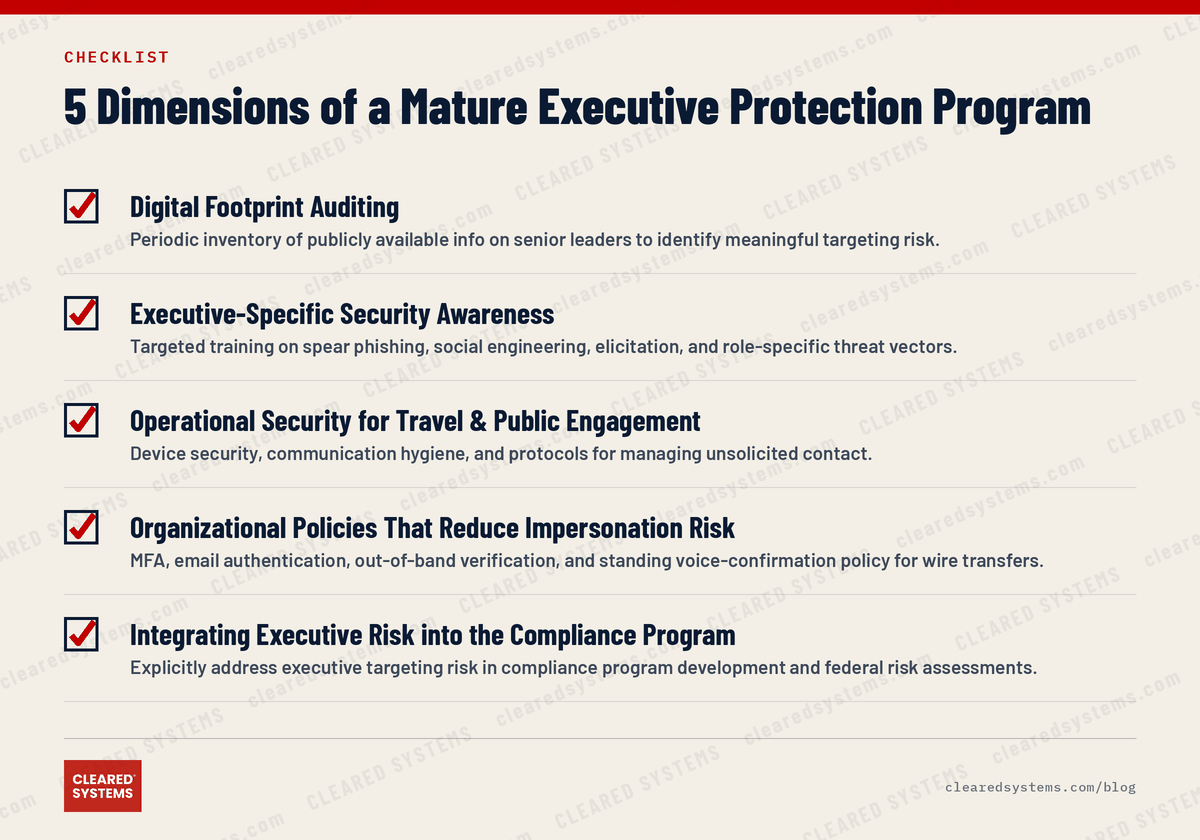
Protecting executives as high-value targets is not solely a technical problem. It requires a combination of digital footprint reduction, awareness training, operational security practices, and organizational policy. Compliance managers and security leaders should evaluate their programs against these dimensions:
Digital Footprint Auditing
Conduct a periodic inventory of publicly available information about senior leaders. Identify what an adversary can aggregate from open sources and determine which disclosures create meaningful targeting risk. This includes reviewing professional profiles, speaking engagements, media appearances, public filings, and social media content — both official and personal.
Executive-Specific Security Awareness
Standard security awareness training is insufficient for executive-level risk. Leaders require targeted education on spear phishing recognition, social engineering tactics, elicitation techniques, and the specific threat vectors applicable to their role and program responsibilities. This training must address the behavioral and social dimensions of the threat, not just technical hygiene. Regulatory vCISO services that include executive advisory can play a critical role in building this capability without requiring a full-time internal resource.
Operational Security for Travel and Public Engagement
Executives who travel internationally or engage in public forums create additional exposure. Device security, communication hygiene, and protocols for managing unsolicited contact from unfamiliar individuals should be part of every executive's operational security baseline. This is particularly relevant for leaders involved in ITAR-regulated programs or those with knowledge of controlled defense technology.
Organizational Policies That Reduce Impersonation Risk
Technical controls — multi-factor authentication, email authentication protocols, out-of-band verification requirements for financial transactions — directly reduce the success rate of impersonation attacks. Equally important are procedural controls: a standing policy requiring voice confirmation before any wire transfer authorization, regardless of how convincing the written request appears, eliminates the most common vector for BEC losses.
Integrating Executive Risk into the Broader Compliance Program
Executive targeting risk should be explicitly addressed in your organization's compliance program development and your federal risk assessment methodology. It is not sufficient to treat it as a separate HR or physical security concern. The threat actors who target executives are often the same actors attempting to compromise your controlled unclassified information environments, and the attack paths frequently converge.
The Organizational Cost of Getting This Wrong
When an executive is successfully targeted, the consequences extend well beyond the immediate financial loss or data exposure. Organizations in the defense industrial base face potential reporting obligations under DFARS cybersecurity clauses, risks to contract eligibility, and in cases involving ITAR-controlled information, potential regulatory liability. Healthcare organizations face HIPAA breach notification obligations. Financial institutions face regulatory scrutiny and reputational damage that is difficult to quantify and slow to recover from.
The investment required to reduce executive targeting risk is modest compared to the potential cost of a single successful attack. The organizations that treat this as an executive benefit rather than a compliance obligation consistently perform better across the full spectrum of cybersecurity risk management metrics.
Cleared Systems is hosting an upcoming session specifically designed for security and compliance leaders who need to understand this threat from the inside out: How to Hack a CEO: Executive Influence and Social Engineering. If your leadership team has not yet confronted this topic directly, this is the right starting point.
Take the Next Step
Executives are high-value targets precisely because their authority and access make them worth the investment of a sophisticated, patient adversary. Reducing that risk requires a deliberate program — not a one-time training session or a single technical control. If you are ready to assess your organization's exposure and build an executive protection posture that holds up under real-world threat conditions, contact Cleared Systems to request a quote. Our team works with defense contractors, federal vendors, and regulated organizations to build practical, audit-ready programs that address risk where it actually lives — including at the top of the org chart.