
What the Insurance Data Security Act Is and Why It Matters
If your organization is licensed by a state insurance department, you have likely encountered — or will soon encounter — the Insurance Data Security Act (IDSA). Modeled on the National Association of Insurance Commissioners (NAIC) Insurance Data Security Model Law, the IDSA has been adopted by a growing number of states. Each adopting state requires covered licensees to maintain a written information security program and, critically, to submit an Insurance Data Security Act annual certification confirming that their program meets the law's requirements.
This post explains what that annual certification actually demands, who is required to file it, who must sign it, and what documentation you need to have in hand before you submit. For current filing windows, applicable fees, and state-specific forms, visit the State Filing Desk, where we maintain current details for each jurisdiction.
Which States Have Adopted the IDSA Model
Adoption has spread steadily since South Carolina first enacted the NAIC model in 2018. States that now require an annual certification include Alabama, Alaska, Delaware, Hawaii, Kentucky, Louisiana, Michigan, Mississippi, New Hampshire, Ohio, South Carolina, Virginia, and Wisconsin, among others. Each state's implementation carries its own nuances in timing, form format, and threshold requirements. Check the individual state filing pages for the jurisdiction where your organization is licensed:
- Alabama insurance data security certification
- Michigan insurance data security certification
- Ohio insurance data security certification
- South Carolina insurance data security certification
- Virginia insurance data security certification
- Wisconsin insurance data security certification
If you are licensed in multiple states, you may owe separate certifications to each insurance department, and the calendars do not always align.
Who Must File the Annual Certification
The IDSA generally applies to any entity licensed, authorized, registered, or otherwise permitted to operate in the insurance industry under the state's insurance laws. This includes insurers, insurance producers, and other licensees. Most states carve out small licensees — typically those with fewer than a defined threshold of employees or falling below a revenue floor — but the exemption is not automatic. You must affirmatively determine whether your organization qualifies.
Even exempt organizations are usually required to maintain basic security controls; they are simply relieved of the formal annual certification filing obligation. If you are unsure whether your organization meets an exemption threshold, treat the certification as required until you have documented your analysis.
What the Certification Actually Covers
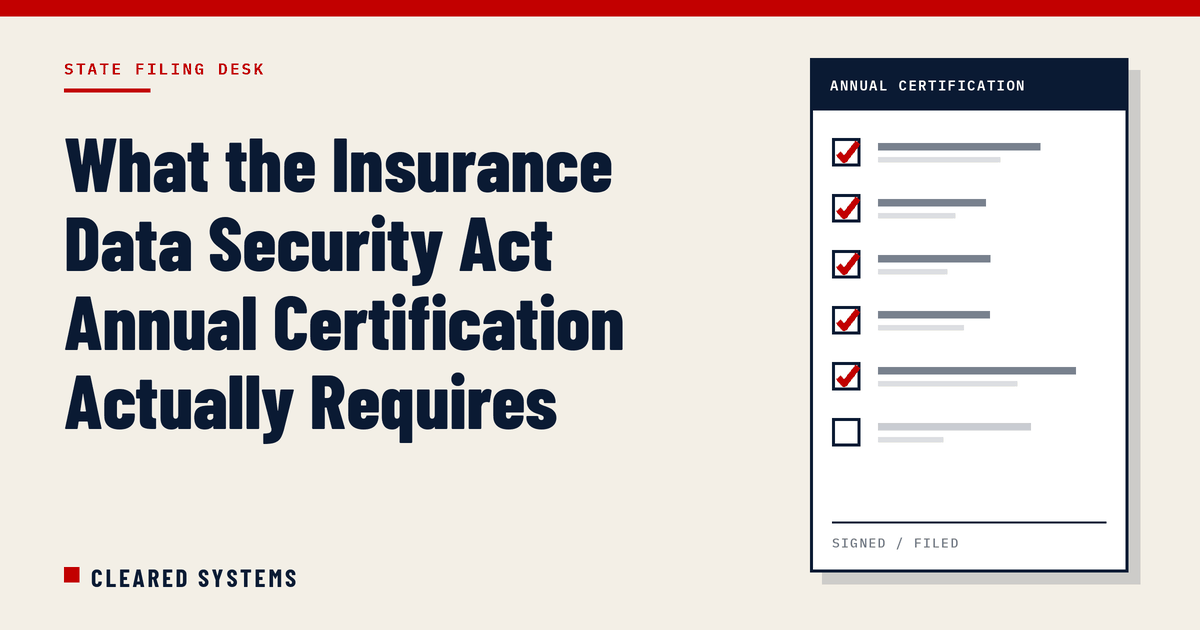
The annual certification is not simply a checkbox. It is a formal attestation that your organization has:
- Adopted a written Information Security Program (ISP) that is based on a risk assessment and proportionate to the size, complexity, and nature of your operations.
- Identified and classified nonpublic information you collect, process, or maintain, including consumer data and employee data covered by the law.
- Implemented administrative, technical, and physical safeguards to protect that nonpublic information against unauthorized access, destruction, use, modification, or disclosure.
- Overseen third-party service providers through written contracts requiring them to implement appropriate security measures and to notify you of cybersecurity events.
- Established an incident response plan that addresses the detection, response to, and recovery from a cybersecurity event, including the state's cybersecurity event notice requirements.
- Reviewed and updated the program annually or whenever a material change occurs that affects the risk environment.
The certification asserts that all of the above are true as of the filing date. Signing without that foundation in place is not a paperwork shortcut — it is a false attestation to your state regulator.
The Risk Assessment Requirement
Most IDSA implementations require a documented risk assessment as the foundation of your Information Security Program. The assessment must identify reasonably foreseeable internal and external threats to nonpublic information, evaluate the likelihood and potential damage of those threats, evaluate the sufficiency of existing safeguards, and support the selection of additional controls. This is not a one-time exercise. The law requires periodic reassessment, and your annual certification implicitly represents that the most recent assessment is current and that your program reflects its findings.
Organizations that also hold federal contracts or handle Controlled Unclassified Information may find that their existing Federal & SLED Risk Assessments provide a strong starting framework, though a formal IDSA-aligned risk assessment must address insurance-specific data types and regulatory expectations.
Third-Party Service Provider Oversight
A commonly overlooked element of the certification is the vendor management requirement. Before signing the annual certification, you must be able to demonstrate that you have identified all third parties with access to nonpublic information, evaluated their security practices, and put appropriate contractual protections in place. If a service provider experienced a cybersecurity event that exposed your policyholders' data and you cannot show due diligence, the certification becomes difficult to defend.
Who Signs the Certification
The certification must be signed by a senior officer of the organization — typically the Chief Executive Officer, Chief Information Security Officer, or an equivalent executive with authority to bind the company on regulatory matters. This is not a task that can be delegated to IT staff or a mid-level compliance manager and filed without executive review. The signing officer is personally attesting to the adequacy of the program, which creates direct accountability at the leadership level.
Organizations that do not have a dedicated security executive should consider whether a Regulatory vCISO arrangement can provide the oversight and documentation support needed to put the certifying officer in a defensible position.
Records You Need to Gather Before Filing
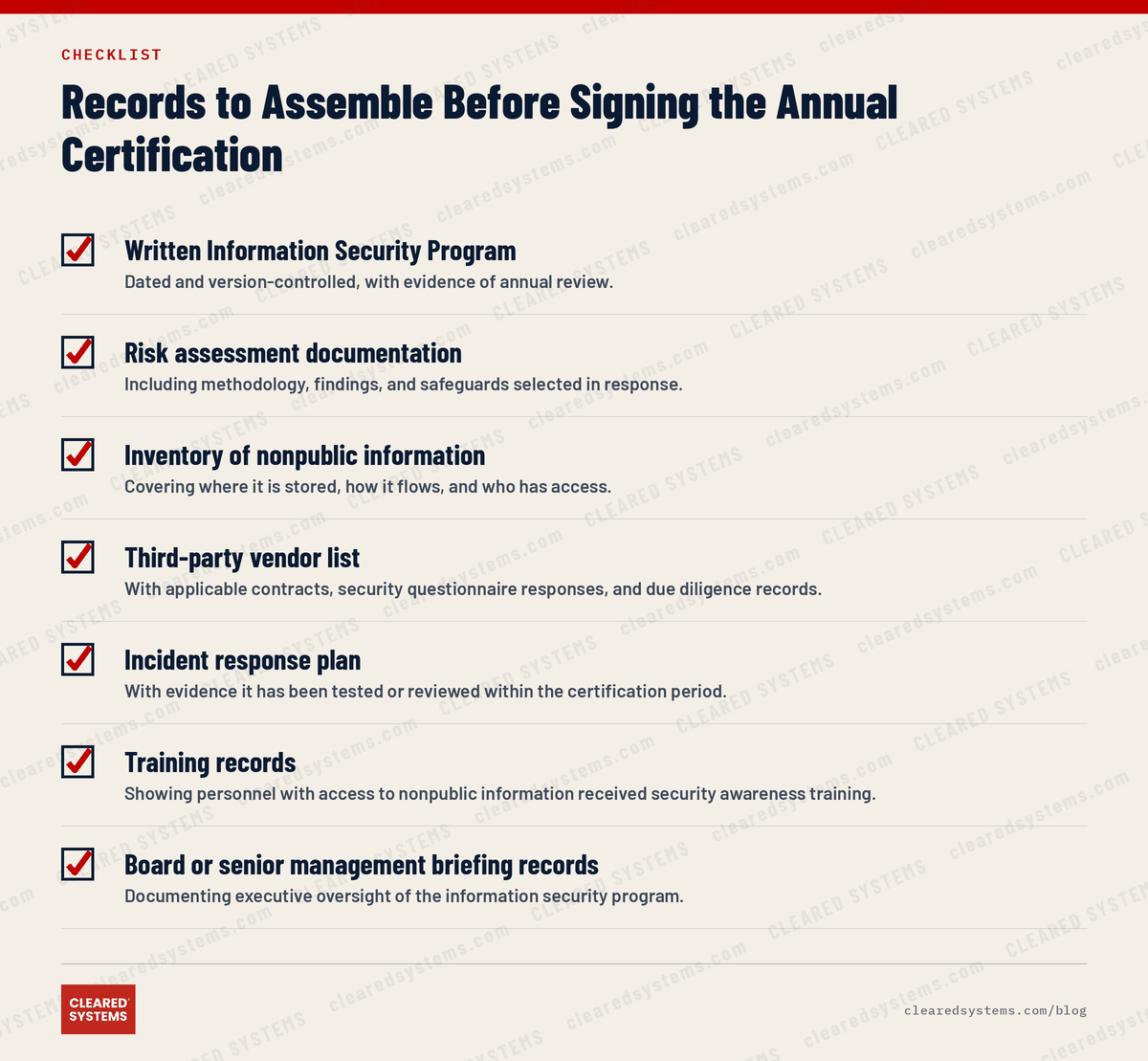
Before an officer signs the annual certification, your compliance team should have assembled and reviewed the following:
- Current written Information Security Program, dated and version-controlled, with evidence of annual review.
- Risk assessment documentation, including methodology, findings, and the safeguards selected in response.
- Inventory of nonpublic information, covering where it is stored, how it flows, and who has access.
- Third-party vendor list with applicable contracts, security questionnaire responses, and due diligence records.
- Incident response plan, including evidence that it has been tested or reviewed within the certification period.
- Training records showing that personnel with access to nonpublic information received security awareness training.
- Board or senior management briefing records documenting executive oversight of the information security program.
- Prior year certification and any remediation actions taken since the last filing.
Having this package assembled before the signing meeting allows the certifying officer to make an informed attestation rather than taking the word of staff that everything is in order.
Cybersecurity Event Notices and Their Relationship to the Certification
The annual certification is a separate obligation from the cybersecurity event notice most states also require. If your organization experienced a qualifying cybersecurity event during the certification period, that notice obligation must have been satisfied independently and on its own timeline. However, any event that occurred, and any remediation steps taken in response, should be reflected in your updated Information Security Program and risk assessment before you file the annual certification. States including Ohio, Michigan, and Delaware maintain separate notice requirements that run on different timelines from the annual certification.
Building and Maintaining the Underlying Program
Many organizations discover during their first certification cycle that they do not have a written Information Security Program that actually meets the IDSA's requirements. They have security controls — firewalls, access restrictions, perhaps a password policy — but not a cohesive, documented, risk-based program tied to a formal assessment and reviewed by senior management.
Closing that gap before the next certification window requires structured program development. Our Compliance Program Development service is designed to help organizations build that foundation, and our IT Compliance Services team can assist with the technical controls documentation that regulators expect to see supporting the program.
For organizations that need ongoing advisory support to maintain the program year over year — not just at certification time — a Regulatory vCISO engagement can provide continuous oversight without the cost of a full-time hire.
How to File
Most states accept the annual certification through the NAIC's State-Based Systems (SBS) portal or through the state insurance department's own online filing system. Some states still accept paper filings by mail. The form itself is typically brief — it asks for basic licensee information, the name and title of the certifying officer, the certification period covered, and the officer's signature. The underlying program documentation is not submitted with the form; it is retained by the licensee and made available to the department upon examination or request.
That distinction matters. Filing the certification is straightforward. Being able to defend it during an examination is where preparation makes the difference.
Visit the State Filing Desk for current form links, portal instructions, and filing window details for each state where you are licensed.
Work With Cleared Systems on Your Annual Certification
Cleared Systems helps insurance licensees navigate the Insurance Data Security Act annual certification process — from assessing your current Information Security Program against the law's requirements, to organizing the documentation your certifying officer needs to sign with confidence. If your program needs to be built or strengthened before this year's filing window, we can help you get there. Visit our State Filing Desk for current state-specific details, or request a quote to discuss where your organization stands today.