
Why Third-Party Vendors Are the Weakest Link in Education Cybersecurity Compliance
Schools and districts today operate in a dense ecosystem of third-party technology vendors: student information systems, learning management platforms, cloud storage providers, assessment tools, and dozens of other applications that touch student and staff data daily. Each of these vendors represents a potential entry point for a breach, a compliance failure, or a regulatory action under federal and state law.
Yet most educational institutions approach vendor relationships the same way they did a decade ago: sign a contract, collect a checkbox on a data privacy agreement, and move on. That approach no longer satisfies the legal or operational realities of education cybersecurity compliance. Schools that fail to impose and enforce meaningful security requirements on their vendors are exposed not only to data breaches but to violations of the Family Educational Rights and Privacy Act (FERPA), the Children's Internet Protection Act (CIPA), and an expanding patchwork of state-level student data privacy laws.
This post is written for compliance managers, technology directors, and executives at educational institutions who want a practical framework for what to require from vendors before granting access to sensitive systems and data.
The Regulatory Foundation: What Laws Actually Apply
Before writing vendor requirements, compliance teams need clarity on the legal baseline. Three frameworks form the core of education cybersecurity compliance in the United States.
FERPA
FERPA governs the privacy of student education records and applies to any institution receiving federal funding. Under FERPA, vendors who access education records on behalf of a school are classified as school officials with legitimate educational interest, but only when they are under direct control of the institution and subject to the same data use restrictions as internal staff. That means your contracts must affirmatively establish those controls. A vendor who receives student data and operates outside of a compliant agreement is not a school official under FERPA; the disclosure of that data may constitute a violation.
CIPA
CIPA applies to schools and libraries receiving E-Rate funding and requires the adoption of internet safety policies, including controls over access to harmful content by minors. Vendors providing internet filtering, networking, or content management services must demonstrably support your CIPA compliance posture. Gaps in vendor configuration can translate directly to institutional liability.
State Student Data Privacy Laws
More than forty states have enacted student data privacy statutes beyond FERPA. Many of these laws impose specific contractual requirements on operators of school service providers, limit the commercial use of student data, and require breach notification within defined windows. Your vendor agreements must reflect the specific requirements of your state. For institutions operating across state lines, that complexity multiplies quickly.
For a broader look at how these frameworks are evolving, see our post on Education Cybersecurity Compliance in 2026: FERPA, CIPA, and Emerging Requirements.
What Educational Institutions Must Require from Vendors
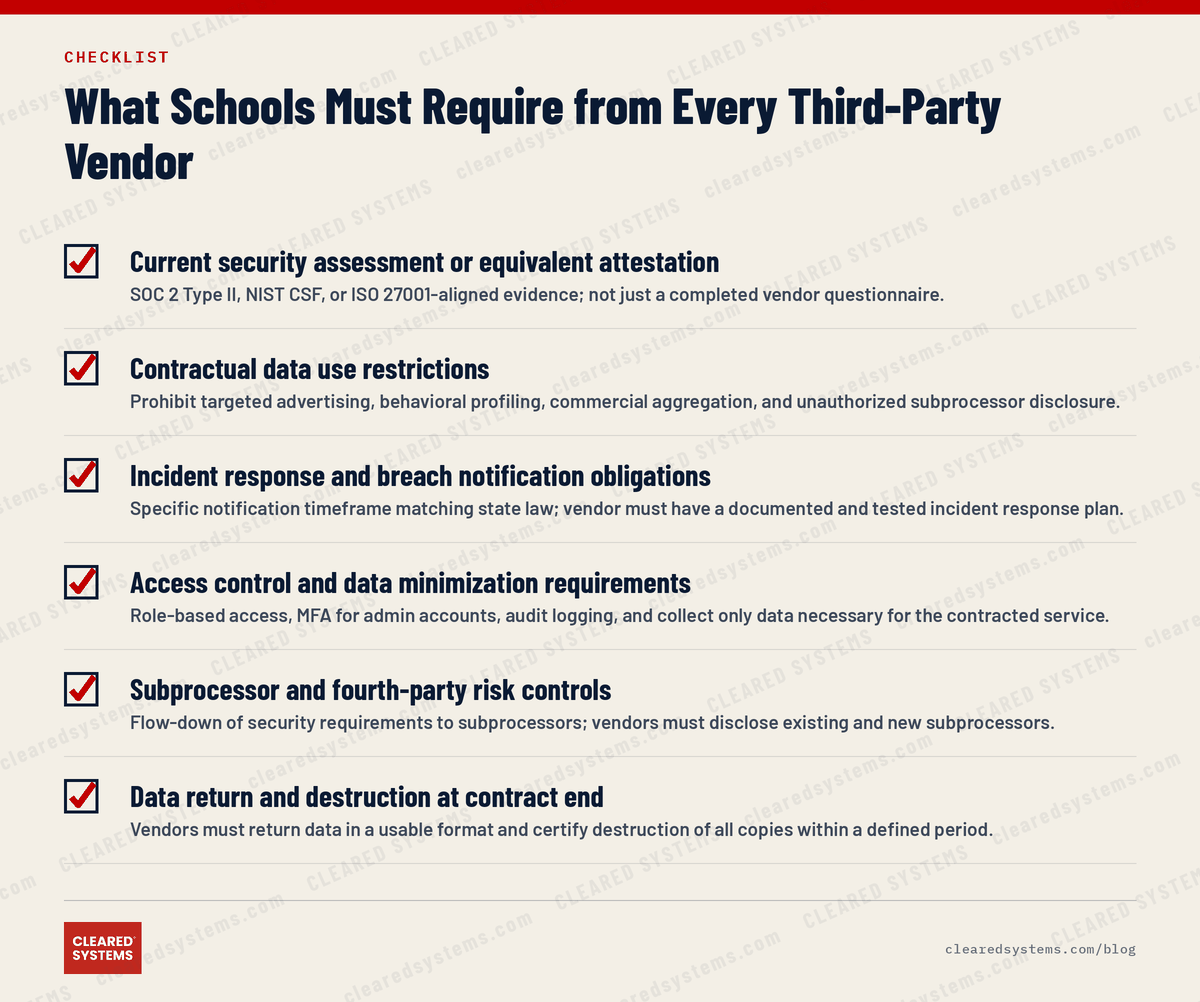
Meeting your legal obligations means moving beyond boilerplate data processing agreements. Here is what a mature vendor security program should require from every third party with access to student, staff, or institutional data.
1. A Current Security Assessment or Equivalent Attestation
Vendors should be able to provide documentation of a recent independent security assessment, a SOC 2 Type II report, or an equivalent attestation aligned to a recognized framework such as NIST CSF or ISO 27001. Schools should not simply accept a completed vendor questionnaire as a substitute for evidence-based assurance. Require vendors to show their work.
If your institution does not have a systematic process for evaluating vendor security posture, our Federal & SLED Risk Assessments service provides a structured approach to assessing and documenting third-party risk in educational and public-sector environments.
2. Contractual Data Use Restrictions
Your data processing agreement must explicitly prohibit vendors from using student data for any purpose beyond the contracted service. This means no targeted advertising, no behavioral profiling, no data aggregation for commercial purposes, and no secondary disclosure to subprocessors without prior written consent. These restrictions are required by most state student data privacy statutes and represent the minimum acceptable standard under FERPA.
3. Incident Response and Breach Notification Obligations
Every vendor contract must include a breach notification clause with a specific, defined timeframe. Many state laws require notification within 30, 48, or 72 hours of discovery. Your contract should require vendor notification to the institution within that window so that your own regulatory obligations can be met. Contracts that contain only vague language about notifying the school promptly after a breach are functionally unenforceable and will not protect you in a regulatory investigation.
Institutions should also confirm that vendors have documented and tested incident response plans. A vendor who cannot produce evidence of a tested plan is a risk that should be escalated before access is granted.
4. Access Control and Data Minimization Requirements
Vendors must implement role-based access controls that restrict access to student and staff data on a need-to-know basis. This includes multi-factor authentication for administrative accounts, audit logging of access to sensitive data, and documented procedures for revoking access when staff or subcontractors separate. Contracts should require vendors to adhere to data minimization principles, collecting and retaining only the data necessary to deliver the contracted service.
5. Subprocessor and Fourth-Party Risk Controls
Many EdTech vendors use their own subcontractors for hosting, analytics, or customer support. Your agreement must require vendors to flow down your data use and security requirements to any subprocessor who receives institutional data. Vendors should be obligated to disclose subprocessors and to notify the institution before adding new ones. This is a commonly overlooked gap that surfaces in audits and enforcement actions.
For a deeper framework on managing this exposure, see our guidance on building a vendor risk management program, which applies many of the same principles to regulated institutional environments.
6. Data Return and Destruction at Contract End
When a vendor relationship ends, what happens to the data? Your agreement must require vendors to return all institutional data in a usable format and to certify destruction of any copies within a defined period. Absent this requirement, student records may persist on vendor systems for years after contract termination, creating ongoing FERPA exposure with no corresponding benefit.
Building a Vendor Onboarding and Monitoring Program
Requiring these controls in contracts is necessary but not sufficient. Educational institutions need a repeatable process for evaluating vendors before onboarding and monitoring them on an ongoing basis. That process should include at least the following elements.
- Pre-contract security review: Evaluate the vendor's security posture before granting any access to institutional systems or data. Use a standardized questionnaire mapped to your regulatory requirements, and review supporting documentation.
- Contract review checklist: Ensure every data processing agreement, terms of service, or master services agreement contains the required provisions before signature. Involve legal counsel for high-risk or high-data-volume vendors.
- Annual reassessment: Security postures change. Require vendors to respond to annual security questionnaires and to notify the institution of material changes to their security program or subprocessor relationships.
- Incident tracking log: Maintain a log of all vendor-reported security incidents, the institution's response, and any notifications made to regulators or affected individuals. This record is essential in the event of a regulatory inquiry.
Institutions that need help building this structure from the ground up should consider our Compliance Program Development service, which can help you design a vendor risk management framework aligned to your specific regulatory obligations.
The Role of IT Compliance in Vendor Oversight
Vendor risk management is not solely a legal or procurement function. The technical controls that vendors deploy, or fail to deploy, are IT compliance issues that require evaluation by qualified security professionals. Schools should ensure that their IT and compliance teams are aligned on the technical standards they expect vendors to meet, including encryption standards for data at rest and in transit, patch management practices, and penetration testing frequency.
Our IT Compliance Services team works with educational institutions to establish and enforce these technical baselines as part of a broader vendor oversight program.
Governance and Accountability at the Leadership Level
Sustainable vendor oversight requires institutional governance, not just contract templates. That means assigning clear ownership for vendor risk management, ensuring that procurement processes include a mandatory security review step, and reporting on vendor risk posture to leadership and the board on a regular basis.
Many institutions lack the in-house security leadership to design and operate this governance structure. A Regulatory vCISO can fill that gap, providing the strategic security leadership necessary to build a vendor oversight program that is defensible under FERPA, state law, and regulatory scrutiny.
For a practical look at how K-12 and higher education institutions can build a full cybersecurity compliance program beyond vendor management, see our post on How K-12 and Higher Education Institutions Can Build a Cybersecurity Compliance Program.
Common Failures That Create Institutional Liability
Based on the patterns we see in education sector engagements, the following failures create the most significant compliance risk when it comes to third-party vendors.
- Allowing vendors to go live before a contract is executed or before the data processing agreement has been reviewed for required provisions.
- Accepting vendor-drafted agreements without reviewing them against your state's student data privacy statute requirements.
- Failing to maintain a current inventory of all vendors with access to student or staff data, including free tools and applications adopted by individual teachers or departments without IT approval.
- Not following up on vendor-reported security incidents to confirm that required notifications were made and that remediation was completed.
- Treating contract execution as the end of the compliance process rather than the beginning of an ongoing oversight relationship.
Our post on the top education cybersecurity compliance failures and what they cost institutions covers these and other patterns in depth.
Take the Next Step
If your institution is working to strengthen vendor oversight, build a defensible compliance program, or prepare for a regulatory review, Cleared Systems can help. Our team brings deep experience in SLED and education sector compliance, and we work with institutions at every stage of program maturity. Visit our Educational Institutions industry page to learn more about how we serve this sector, or request a quote to start a conversation about your specific needs and compliance priorities.