
Why Documentation Is the Deciding Factor in a Cybersecurity Audit
Most compliance managers understand that having security controls in place is not enough. When a federal auditor, a C3PAO assessor, or a DCSA reviewer walks through your door, the first question is never "What do you have running?" It is "Show me your documentation." The gap between organizations that pass audits and those that scramble to explain themselves often comes down to one thing: whether the right records exist, are current, and are organized well enough to be useful under pressure.
Effective cybersecurity risk management is not just a technical discipline. It is a documentation discipline. The frameworks that govern defense contractors—NIST SP 800-171, CMMC, DFARS 252.204-7012, and others—all require evidence that your organization has identified its risks, made deliberate decisions about them, and tracked those decisions over time. Without that paper trail, even a technically strong program can fail an assessment.
This post identifies the core documents auditors look for during a cybersecurity risk management review, explains why each one matters, and offers practical guidance on making sure yours are audit-ready.
The Core Documentation Set Auditors Expect to Find
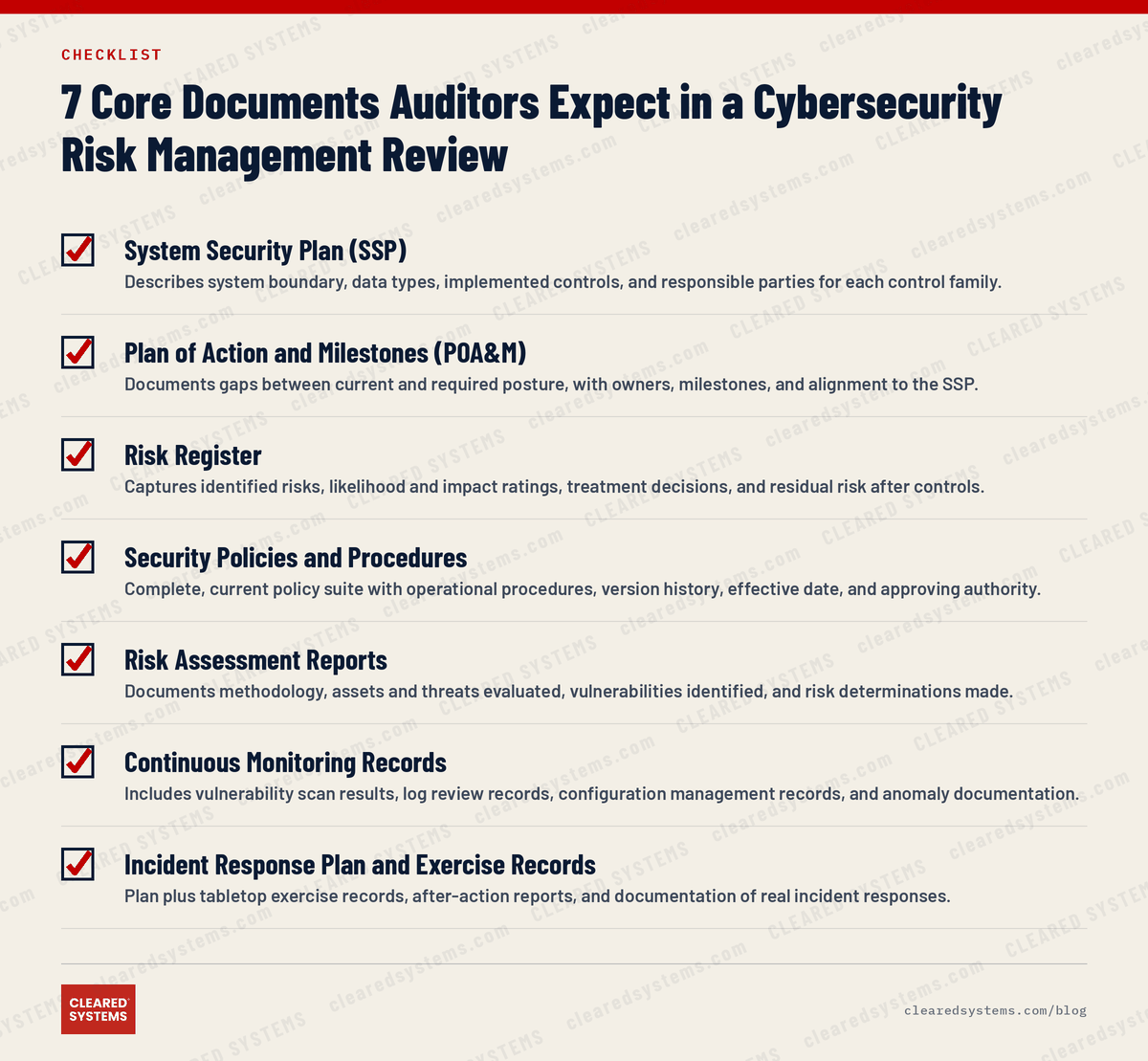
1. The System Security Plan (SSP)
The System Security Plan is the foundation of your cybersecurity risk management documentation. It describes your information system boundary, the data types in scope, the security controls you have implemented or plan to implement, and the responsible parties for each control family. For contractors operating under NIST SP 800-171 or CMMC Level 2, the SSP is not optional—it is a scored artifact.
Auditors look at your SSP to understand whether your organization has actually thought through its environment. A thin, template-driven SSP that does not reflect your actual network architecture, your actual users, or your actual policies will raise immediate red flags. The SSP needs to be a living document, updated when systems change, personnel shift, or new technologies are introduced. For a deeper look at how the SSP works alongside your remediation tracking, see our earlier post on SSP and POA&M as critical components of a strong security program.
2. The Plan of Action and Milestones (POA&M)
No organization achieves a perfect security posture overnight. The POA&M exists to document the gap between where you are and where you need to be, along with a credible plan to close it. Auditors do not automatically penalize you for open findings on a POA&M—they penalize you for having no POA&M, for items that have sat unaddressed for years with no milestones, or for a POA&M that does not align with your SSP.
A well-maintained POA&M demonstrates management commitment. It shows that leadership is aware of the risks, that someone owns each remediation item, and that realistic deadlines have been set. If your POA&M is a static spreadsheet that has not been touched since the last audit, it will work against you rather than for you.
3. The Risk Register
Your risk register is the primary evidence that your organization conducts ongoing cybersecurity risk management rather than point-in-time compliance exercises. It should capture identified risks, their likelihood and impact ratings, your treatment decisions (accept, mitigate, transfer, avoid), the controls tied to each risk, and the residual risk after controls are applied.
Auditors reviewing a risk register want to see that it is tied to your business context—not a generic list copied from a framework appendix. Risks should reflect your actual threat environment: your supply chain exposure, your data types, your user population, and your operational dependencies. A well-structured risk register entry includes enough detail to be traceable back to specific controls and forward to remediation actions.
4. Security Policies and Procedures
Auditors expect to see a complete, current policy suite that maps to the control families you are required to address. This means not just high-level policies but operational procedures that explain how the policy is implemented in practice. A policy that says "access to CUI systems shall be restricted to authorized personnel" needs a corresponding procedure explaining exactly how access is provisioned, reviewed, and revoked.
Policies that have not been reviewed within the past year, that are not signed by an authorizing official, or that contradict what auditors observe during technical review are among the most common audit findings. Policy documents should include a version history, effective date, review date, and the name or title of the approving authority.
5. Risk Assessment Reports
Your organization should conduct formal risk assessments on a defined schedule and whenever significant changes occur. The resulting reports document the methodology used, the assets and threats evaluated, the vulnerabilities identified, and the risk determinations made. These reports are distinct from vulnerability scan outputs—they represent an analytical process, not just a tool output.
Under NIST SP 800-171 and CMMC, risk assessments are a required practice. Auditors will ask to see the most recent report and may compare its findings to your current POA&M and risk register to verify consistency. Organizations that work with our Federal & SLED Risk Assessments practice receive structured deliverables that are designed to satisfy this documentation requirement from the moment they are produced.
6. Continuous Monitoring Records
Auditors increasingly expect to see evidence that security controls are being monitored on an ongoing basis, not just assessed annually. This includes vulnerability scan results, log review records, configuration management records, and documentation of any anomalies detected and how they were resolved. The absence of continuous monitoring records suggests that your security program exists on paper only.
Continuous monitoring documentation should be retained according to your records retention policy and should be traceable to specific systems and time periods. If an auditor asks for evidence that you reviewed privileged account activity last quarter, you should be able to produce it in minutes.
7. Incident Response Plan and Exercise Records
Your incident response plan tells auditors that your organization has thought through what happens when something goes wrong. But the plan alone is not sufficient—auditors want to see evidence that it has been tested. Tabletop exercise records, after-action reports, and any documentation of real incident responses all serve as evidence that the plan is operational, not theoretical.
Under DFARS 252.204-7012 and CMMC, contractors are required to report cyber incidents to DoD within 72 hours of discovery. Having documented procedures that align with those reporting requirements is a specific area of auditor scrutiny. If your incident response documentation has not been updated to reflect current reporting channels and notification templates, that gap should be addressed immediately.
Common Documentation Failures That Derail Audits
Across dozens of engagements supporting federal defense contractors and other regulated organizations, we see the same documentation failures appear repeatedly. Understanding them in advance is the fastest way to avoid them.
- Documents that describe an ideal state rather than the actual environment. An SSP that describes controls you plan to implement as if they are already in place is a material misrepresentation. Auditors verify claims against technical evidence, and inconsistencies undermine your entire submission.
- Orphaned documents with no owner. Every compliance document should have an identified owner responsible for keeping it current. Documents that belong to no one tend to go stale quickly.
- Inconsistency across documents. If your risk register identifies a vulnerability but your POA&M does not include a remediation item for it, auditors will notice. Your documentation set needs to tell a coherent, internally consistent story.
- Missing evidence of management review. Risk acceptance decisions, policy approvals, and assessment findings all require documented management sign-off. Verbal approvals do not satisfy audit requirements.
- No version control. Producing an undated document during an audit—or producing multiple versions with no clear indication of which is current—creates unnecessary confusion and signals weak document management practices.
Building Documentation That Supports Your Program, Not Just Your Audit
The organizations that consistently perform well under audit are not those that sprint to produce documents before an assessment. They are organizations that have built documentation practices into their daily operations. That means assigning document ownership, scheduling regular reviews, connecting documentation workflows to change management processes, and training staff on what records they are responsible for maintaining.
A structured compliance program treats documentation as infrastructure rather than overhead. When your documentation accurately reflects your environment and your risk decisions, it becomes a management tool—something that helps leadership understand the organization's true security posture and make informed resource allocation decisions.
Organizations that benefit from fractional security leadership often find that a Regulatory vCISO can serve as the documentation governance owner, ensuring that the full set of required artifacts stays current, coherent, and audit-ready year-round. This is particularly valuable for mid-size defense contractors who do not have a full-time CISO on staff but face the same documentation requirements as much larger organizations.
For contractors specifically pursuing CMMC certification, our guide on organizing CMMC documentation so assessors can navigate it easily offers additional practical detail on structure and presentation.
Aligning Documentation to the Frameworks That Govern Your Organization
Not every organization faces the same documentation requirements. A prime contractor handling Controlled Unclassified Information under CMMC Level 2 has a different documentation burden than a healthcare organization subject to HIPAA, or a financial institution operating under GLBA. What is consistent across all of them is the underlying logic: identify your risks, document your controls, track your gaps, and demonstrate that management is engaged.
If you operate across multiple regulatory frameworks—as many defense contractors and federal vendors do—your documentation strategy needs to account for the overlap and the divergence. A single risk register can serve multiple frameworks if it is structured correctly. A single set of policies can address NIST SP 800-171 and CMMC simultaneously if the control mapping is explicit. Building that multi-framework coherence is a core part of what our CMMC, CUI & DFARS Compliance practice delivers.
Take the Next Step Toward Audit-Ready Documentation
If your cybersecurity risk management documentation would not hold up to a serious audit today, the time to address that is before you receive notice of an assessment—not after. Cleared Systems works with defense contractors, federal agencies, and regulated organizations to build documentation programs that satisfy auditor expectations while actually supporting day-to-day security operations. Request a quote to discuss where your documentation stands and what it would take to get it where it needs to be.