
Why a Compliance Program Assessment Is Not an Audit
Compliance managers and executives in defense contracting, healthcare, and other regulated industries often confuse a compliance program assessment with a regulatory audit. The distinction matters. An audit is typically performed by an external authority—a C3PAO, DCSA, OCR, or a similar body—to determine whether your organization meets a specific standard at a point in time. A compliance program assessment is an internal or consulting-led review designed to evaluate how well your compliance infrastructure functions across people, processes, documentation, and controls.
The goal is not to grade you against a checklist. It is to give leadership an honest picture of where the program is strong, where it is fragile, and what must change before the regulator, auditor, or contracting officer arrives. Done well, an assessment becomes the foundation for every remediation decision you make over the next twelve to thirty-six months.
What a Compliance Program Assessment Examines
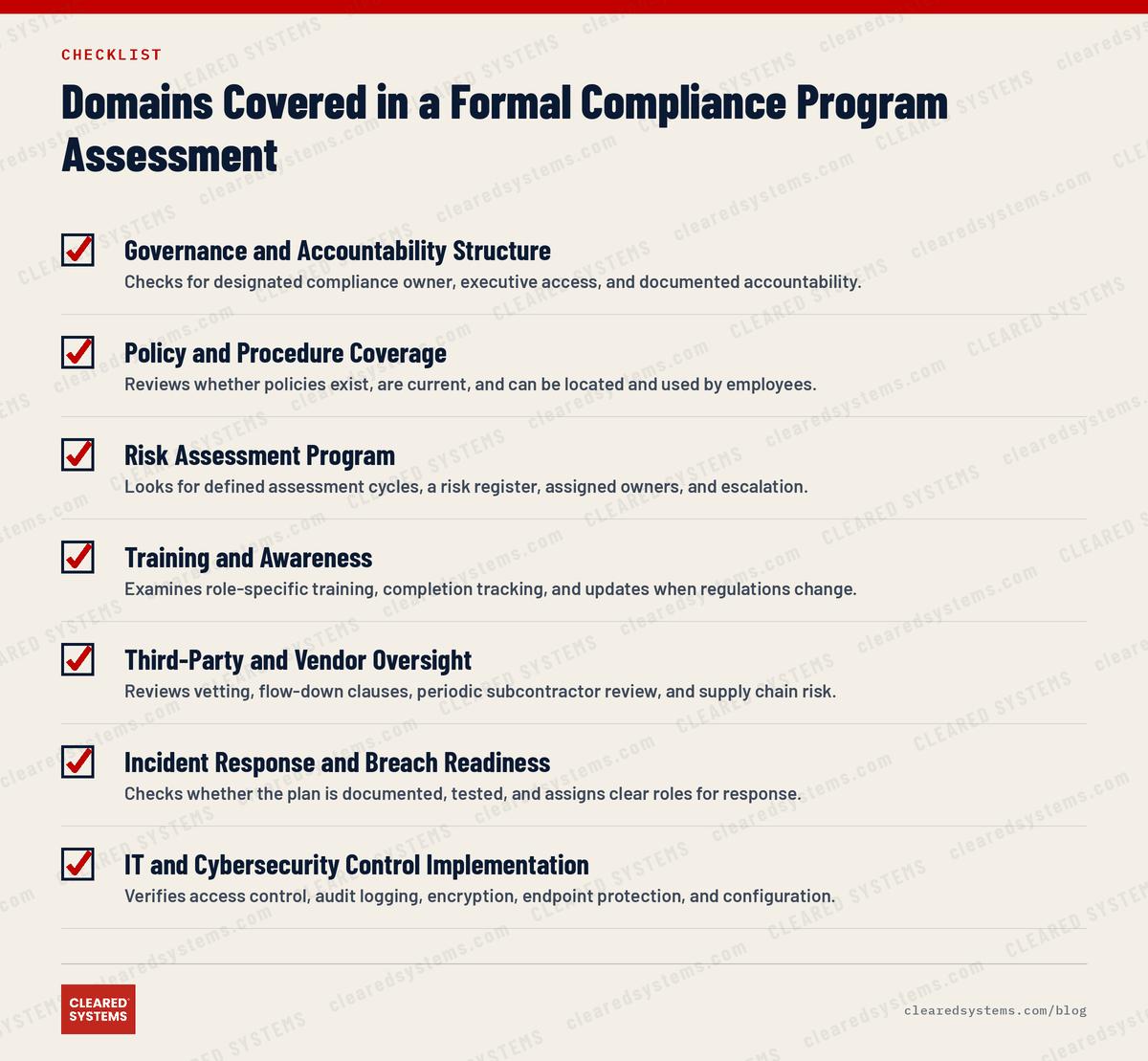
A formal assessment is structured to examine every layer of a compliance program, not just the technical controls that IT teams typically focus on. At Cleared Systems, our Compliance Program Development engagements begin with exactly this kind of structured review before any remediation work starts. The scope of a well-designed assessment covers the following domains.
Governance and Accountability Structure
Assessors examine whether your organization has clearly assigned compliance ownership. This means looking at whether a designated compliance officer or equivalent role exists, whether that role has executive access and authority, and whether accountability is documented in job descriptions, policies, and reporting structures. Many organizations discover during this phase that compliance responsibilities are informally distributed across IT, legal, and operations without a clear owner—a structural weakness that creates blind spots and slows incident response.
Policy and Procedure Coverage
Every regulated framework requires a documented policy foundation. Assessors review whether policies exist for the domains your applicable frameworks require, whether those policies are current, whether they are written at an appropriate level of specificity, and whether employees can actually locate and use them. Organizations pursuing CMMC, CUI, and DFARS compliance frequently discover that their policy libraries were written to pass an initial review and have not been updated to reflect operational realities or regulatory changes.
Risk Assessment Program
A compliance program without a functioning risk assessment process is a static document set, not a living program. Assessors look for evidence that your organization conducts risk assessments on a defined cycle, that findings are documented in a risk register, that risks are assigned owners and remediation timelines, and that risk decisions are escalated appropriately. Our Federal and SLED Risk Assessment practice supports organizations that need to build or rebuild this function from the ground up.
Training and Awareness
Regulatory frameworks from HIPAA to ITAR to CMMC all require documented training programs. An assessment examines whether training is role-specific, whether completion is tracked, whether training content is updated when regulations or internal processes change, and whether employees in high-risk roles receive additional instruction. Training gaps are among the most common findings in compliance program assessments, and they carry disproportionate risk because regulators treat them as evidence of management indifference.
Third-Party and Vendor Oversight
Defense contractors and healthcare organizations both face significant third-party risk. Assessors review whether vendor onboarding includes compliance vetting, whether business associate agreements or flow-down clauses are in place, whether subcontractors handling controlled data are subject to periodic review, and whether supply chain risks are captured in your risk register. This area has become a focal point for DoD contracting officers and OCR investigators alike.
Incident Response and Breach Readiness
An assessment examines whether your incident response plan is documented, whether it has been tested through tabletop exercises, whether notification timelines align with applicable regulatory requirements, and whether the plan designates clear roles for legal, communications, and executive decision-making. A plan that exists on paper but has never been practiced is a liability, not an asset.
Export Controls and Specialized Regulatory Requirements
For defense contractors, the assessment must also cover specialized regulatory domains. Organizations subject to ITAR need their ITAR and export controls compliance program evaluated separately, including technology control plans, foreign national access controls, commodity jurisdiction determinations, and recordkeeping practices. These requirements sit outside the typical IT-centric compliance review and require subject matter expertise that many generalist assessors do not bring.
IT and Cybersecurity Control Implementation
Even though a compliance program assessment is broader than a technical audit, it must examine whether cybersecurity controls required by your applicable frameworks have been implemented and can be demonstrated. This includes access control, audit logging, encryption, endpoint protection, and configuration management. Our IT Compliance Services practice supports organizations that need hands-on technical remediation after assessment findings surface control gaps.
What a Compliance Program Assessment Produces
The deliverables from a formal assessment should be specific enough to drive decisions, not generic enough to be ignored. A well-structured assessment produces the following outputs.
A Current-State Findings Report
This is the primary output. It documents what was reviewed, what was found, and how findings were evaluated against the applicable regulatory or contractual standard. Findings are typically categorized by severity—critical gaps that create immediate legal or contractual exposure, significant gaps that require remediation within a defined window, and observations that represent best-practice improvements rather than compliance failures.
A Gap Analysis Mapped to Specific Requirements
Unlike a narrative findings report, a gap analysis maps each finding to the specific control, clause, or regulatory requirement it implicates. For a defense contractor, this means mapping findings to NIST SP 800-171 control families, DFARS clauses, or CMMC practices. For a healthcare organization, it means mapping to HIPAA administrative, physical, and technical safeguard requirements. This mapping allows compliance managers to prioritize remediation work based on regulatory exposure rather than internal preference.
A Prioritized Remediation Roadmap
An assessment that produces only a list of problems without guidance on sequence and ownership has limited operational value. A prioritized remediation roadmap tells you which gaps to close first, what resources each remediation requires, what the realistic timeline looks like, and which gaps can be addressed with procedural changes versus which require technology investment or staff additions. This roadmap becomes the working document that drives program improvement through the next assessment cycle.
An Executive Summary
Compliance managers need detail. Executives and boards need context. A formal assessment produces a concise executive summary that translates technical and regulatory findings into business risk language—contract eligibility risk, enforcement exposure, reputational consequences, and investment priorities. Organizations that engage our Regulatory vCISO Services often use the executive summary from a compliance program assessment as the foundation for their board-level security reporting.
Documentation Inventory and Recommendations
Many compliance programs have documentation that exists in fragmented form across shared drives, email threads, and individual hard drives. The assessment produces a documentation inventory that identifies what exists, what is missing, what is outdated, and what needs to be consolidated into a defensible document management system. This inventory is particularly valuable in advance of a formal audit, where the ability to produce evidence quickly is as important as having evidence at all.
Who Should Commission a Compliance Program Assessment
A compliance program assessment is appropriate for any organization that meets one or more of the following conditions: you are preparing for a formal third-party audit or government review; you have experienced a significant regulatory change; you have grown through acquisition or significant operational expansion; you have never conducted a structured review of your compliance infrastructure; or you have concerns that your current program reflects documentation rather than operational reality.
Defense contractors pursuing CMMC certification should treat a compliance program assessment as a prerequisite to formal audit preparation—not as a substitute for it. The assessment surfaces the gaps; the remediation work closes them; the formal audit validates the result. Organizations that skip the assessment and go directly to audit preparation consistently underestimate the scope of their remediation requirements and compress their timelines in ways that increase both cost and risk.
Similarly, organizations in healthcare that handle protected health information and are subject to OCR oversight benefit from a structured compliance program assessment before each annual HIPAA security risk analysis cycle, since the assessment ensures that the risk analysis is conducted against a program that is actually functioning rather than one that exists only in policy documents.
How Often Should You Conduct One
For most organizations operating under federal contracts or regulated healthcare frameworks, an annual compliance program assessment is the appropriate baseline. Organizations that are actively pursuing certification milestones, responding to regulatory changes, or integrating acquired companies may require more frequent assessments. The key principle is that a compliance program assessment should be a planned, recurring activity—not a reactive response to a failed audit or a government inquiry.
Between formal assessments, organizations should maintain continuous monitoring practices, conduct periodic internal reviews against the remediation roadmap, and ensure that changes to the operating environment trigger a targeted review of affected program elements. Our Regulatory vCISO Services provide ongoing advisory support that keeps compliance programs current between formal assessment cycles.
Take the Next Step
If your organization has never conducted a formal compliance program assessment, or if your last one produced a report that never translated into action, Cleared Systems can help. Our team brings deep expertise across defense contracting, federal regulatory frameworks, and healthcare compliance. Visit our Compliance Program Development service page to understand what a structured engagement with Cleared Systems includes, or request a quote to discuss your organization's specific requirements with our team.