
Why Microsoft GCC High Exists and Who It Is Built For
Microsoft's Government Community Cloud High — universally known as GCC High — is not a marketing tier. It is a purpose-built cloud environment designed to meet the most stringent federal data-handling requirements in existence. If your organization works with Controlled Unclassified Information (CUI), handles International Traffic in Arms Regulations (ITAR) data, or is pursuing Cybersecurity Maturity Model Certification (CMMC), GCC High is almost certainly the cloud environment your contracts demand.
The confusion I see most often in my work with defense contractors is the assumption that any government-flavored Microsoft offering provides the same protections. It does not. Understanding exactly who qualifies, what the environment actually delivers, and what your organization must still do independently is the difference between genuine GCC High compliance and a false sense of security that creates serious contractual and legal exposure.
Who Qualifies for Microsoft GCC High
Microsoft restricts GCC High access to a defined set of organizations. Eligibility is not self-declared — Microsoft performs a vetting process, and not every organization that applies will be approved for direct enrollment. The qualifying categories include:
- Defense Industrial Base (DIB) contractors that handle CUI subject to DFARS clause 252.204-7012 or that are pursuing CMMC certification at any level
- Organizations with ITAR obligations, meaning companies that manufacture, export, or broker defense articles and services on the United States Munitions List (USML)
- Federal agencies and their direct contractors operating under requirements that mandate FedRAMP High authorization or Department of Defense Impact Level 4 (IL4) or IL5 equivalency
- Subcontractors and suppliers in the defense supply chain who receive CUI or ITAR-controlled technical data from a prime contractor
- Cleared defense contractors operating under facility clearances issued by the Defense Counterintelligence and Security Agency (DCSA)
If your organization falls outside these categories — for example, a commercial software company without any federal contracts or CUI obligations — you likely do not qualify and do not need GCC High. Standard commercial Microsoft 365 or even the lower-tier GCC environment may be appropriate. The key question your compliance team must answer is whether your data obligations require a FedRAMP High authorized environment with data residency restricted to the United States and operated exclusively by U.S. persons.
For a detailed side-by-side look at the two government cloud tiers, our post on which compliance tier your organization actually needs walks through the decision in plain terms.
What GCC High Actually Provides — and What It Does Not
GCC High is a significant compliance enabler, but it is not a compliance solution by itself. Here is what the environment genuinely delivers:
- FedRAMP High authorization, which satisfies the cloud service provider baseline required by DFARS 252.204-7012 for covered defense information
- Data residency within the United States, with access restricted to screened U.S. persons — a critical requirement for ITAR technical data stored or transmitted in the cloud
- Separation from commercial Microsoft infrastructure, meaning your data does not share physical or logical boundaries with non-government tenants
- Support for DoD IL4 workloads, enabling organizations that must meet DoD cloud computing security requirements to use GCC High as a compliant platform
- Built-in Microsoft compliance tools including Microsoft Purview, Microsoft Defender, and Microsoft Intune that can be configured to support your CMMC and NIST 800-171 controls
What GCC High does not do is configure itself, enforce your policies, or satisfy your CMMC or ITAR obligations without deliberate action on your part. The platform provides the right container. What goes inside that container — your policies, your access controls, your data labeling, your audit logging — remains your organization's responsibility. Many contractors make the costly mistake of assuming that migrating to GCC High closes their compliance gaps. It does not. It opens the door to achieving compliance, but you must walk through it.
The Core Compliance Requirements Once You Are in GCC High
Once your organization is operating in GCC High, your compliance obligations do not end — they begin in earnest. The following are the primary areas where organizations must take independent action to achieve and maintain Microsoft GCC High compliance.
CUI Identification, Marking, and Handling
Moving to GCC High does not automatically identify or protect your CUI. Your team must inventory where CUI lives, apply appropriate markings using Microsoft Purview sensitivity labels, enforce access controls so only authorized U.S. persons can reach CUI, and document how CUI flows through your environment. This work must be performed and maintained continuously. For contractors still building their CUI practices, our existing resource on everything you need to know about CUI provides a solid starting point.
NIST SP 800-171 and CMMC Controls
GCC High supports implementation of the 110 security requirements in NIST SP 800-171 and the 110 practices required at CMMC Level 2, but support is not implementation. Your organization must configure multifactor authentication, enforce conditional access policies, enable audit logging and SIEM integration, establish incident response procedures, conduct regular access reviews, and maintain a System Security Plan (SSP) and Plan of Action and Milestones (POA&M). These requirements exist independent of your cloud platform. GCC High makes them achievable — your compliance program makes them real. Our CMMC, CUI, and DFARS compliance services are specifically structured to help contractors close these gaps systematically.
ITAR Controls for Technical Data in the Cloud
For organizations with ITAR obligations, GCC High addresses the foreign person access concern by restricting the environment to U.S. persons. However, your organization must still implement and enforce technology control procedures, ensure that ITAR-controlled technical data is labeled and segregated appropriately, maintain records of who accesses that data, and train employees on their obligations. GCC High is an enabling condition for ITAR cloud compliance — not a substitute for a full ITAR compliance program. Our team works with contractors daily on this intersection, and our post on achieving ITAR compliance in GCC High details what a properly structured program looks like.
Tenant Configuration and Hardening
A new GCC High tenant arrives with many features disabled or in permissive default states. Your IT and compliance teams must systematically harden the environment: enforce device compliance policies through Microsoft Intune, enable data loss prevention policies in Microsoft Purview, configure Microsoft Defender for Endpoint with settings aligned to CMMC requirements, restrict guest access, enable unified audit logging, and establish baseline configurations that match your SSP documentation. Every configuration decision must be documented because CMMC assessors will ask you to demonstrate that your technical controls match what your policies claim.
Ongoing Monitoring and Continuous Compliance
CMMC and DFARS compliance are not point-in-time achievements. Your GCC High environment must be monitored continuously for configuration drift, unauthorized access attempts, and changes to the boundary of your CUI environment. Regular internal audits, annual NIST 800-171 self-assessments submitted to the Supplier Performance Risk System (SPRS), and periodic gap assessments are all part of maintaining the compliance posture your contracts require.
Common Mistakes Organizations Make When Pursuing GCC High Compliance
In my experience advising defense contractors through GCC High migrations and compliance programs, the same failure patterns emerge repeatedly:
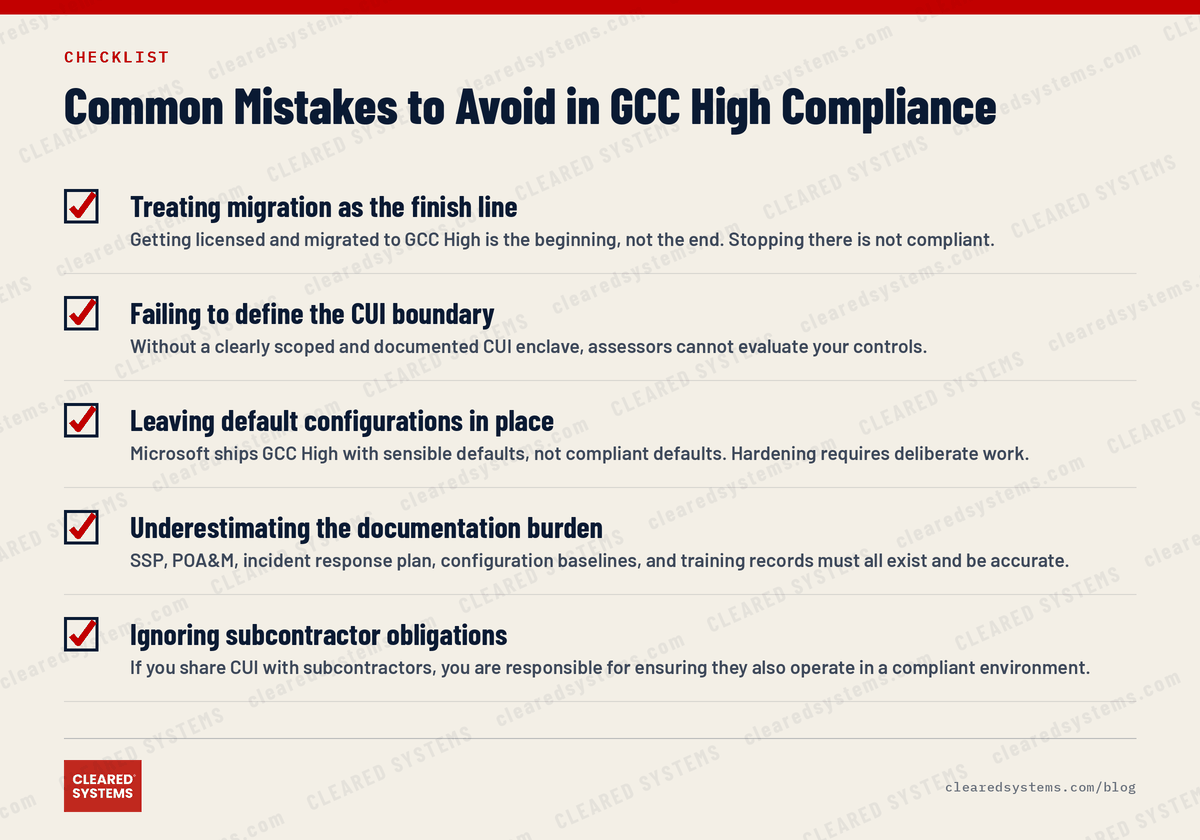
- Treating migration as the finish line. Getting licensed and migrated to GCC High is the beginning, not the end. Organizations that stop there are not compliant.
- Failing to define the CUI boundary. Without a clearly scoped and documented CUI enclave, assessors cannot evaluate your controls and you cannot defend your posture.
- Leaving default configurations in place. Microsoft ships GCC High with sensible defaults, not compliant defaults. Hardening requires deliberate configuration work.
- Underestimating the documentation burden. Your SSP, POA&M, incident response plan, configuration baselines, and training records must all exist and must accurately reflect your actual environment.
- Ignoring subcontractor obligations. If you share CUI with subcontractors, you are responsible for ensuring they also operate in a compliant environment. GCC High does not automatically extend to your supply chain.
Our post on the five costliest mistakes in GCC High compliance goes deeper on each of these failure modes with specific remediation guidance.
How Cleared Systems Supports GCC High Compliance Programs
At Cleared Systems, we support defense contractors, federal agencies, and regulated industry organizations at every stage of their GCC High compliance journey. Our IT compliance services encompass GCC High tenant configuration, CUI boundary scoping, CMMC control implementation, and ongoing compliance monitoring. For organizations that need executive-level security leadership without a full-time hire, our regulatory vCISO services provide the strategic oversight necessary to manage a GCC High compliance program across all relevant frameworks simultaneously.
We also support the documentation, policy development, and gap assessment work that makes the difference between a GCC High environment that looks compliant and one that actually is. Visit our CMMC, CUI, and DFARS compliance services page to understand the full scope of what a structured engagement includes.
Take the Next Step
If your organization is determining whether GCC High is required, preparing for a migration, or working to close compliance gaps in an existing GCC High environment, Cleared Systems can help you move from uncertainty to a defensible compliance posture. Request a quote to speak with our team about where your program stands and what a structured path forward looks like for your specific contract obligations and risk profile.