
Why MIL-STD-130 Compliance Falls on the Production Floor
Most compliance conversations in the defense industrial base center on cybersecurity frameworks and export controls. But for manufacturers delivering hardware to the Department of Defense, MIL-STD-130 compliance is just as operationally critical—and the production manager, not the compliance officer, is usually the person standing between a conforming shipment and a contract dispute.
MIL-STD-130, Identification Marking of U.S. Military Property, establishes the requirements for how defense items must be marked so they can be uniquely identified, tracked, and accounted for across the entire lifecycle of government property. When these requirements are not met correctly at the point of manufacture, the consequences range from rejected shipments and rework costs to audit findings that threaten contract continuity.
This walkthrough is written for production managers and compliance leads who need a practical, checkpoint-by-checkpoint understanding of what MIL-STD-130 demands and where programs typically break down. For organizations that need hands-on support across the full scope of IUID obligations, our IUID Marking Verification & Compliance Support service covers exactly these requirements.
Checkpoint 1: Determine Which Items Require Unique Item Identification
The first decision a production manager must get right is item scoping. Not every piece of hardware flowing through a production line requires a Unique Item Identifier (UII), but the criteria for determining which items do are more nuanced than many teams assume.
Under MIL-STD-130 and the broader IUID policy framework established through DFARS, items generally require unique identification when they meet one or more of the following conditions:
- They are delivered under a contract that includes the DFARS IUID clause (252.211-7003)
- They have a unit acquisition cost at or above the DoD threshold for serially managed items
- They are mission-critical or controlled inventory items regardless of cost
- They are embedded items that meet the threshold when aggregated into a higher-level assembly
The contract's Contract Data Requirements List (CDRL) and the Statement of Work are your primary reference documents. Production managers should work with contracts personnel early in a program to validate the item list before marking decisions are made. Errors at this stage create cascading problems downstream.
Checkpoint 2: Construct the Correct Unique Item Identifier
The UII is a globally unique identifier constructed according to one of two approved formats under MIL-STD-130: the concatenated UII using the enterprise identifier plus a serial number, or a DoD-recognized format such as an ISO or GS1 construct.
For most defense contractors, the preferred construct is the enterprise identifier—typically a Commercial and Government Entity (CAGE) code—combined with a part number and serial number sequence that the contractor controls. The critical production-floor checkpoint here is ensuring that no two items leaving your facility ever carry the same UII, and that the UII you assign is registered consistently in the DoD Item Unique Identification Registry.
Common failures at this stage include:
- Serial number reuse across production runs or contract lines
- Inconsistent enterprise identifier formatting between the physical mark and the registry submission
- UII construction that does not match the data construct declared in the IUID submission package
The manufacturing sector carries a disproportionate share of IUID nonconformance findings precisely because UII construction is treated as a one-time setup task rather than an actively governed production process.
Checkpoint 3: Select and Apply the Correct Marking Method
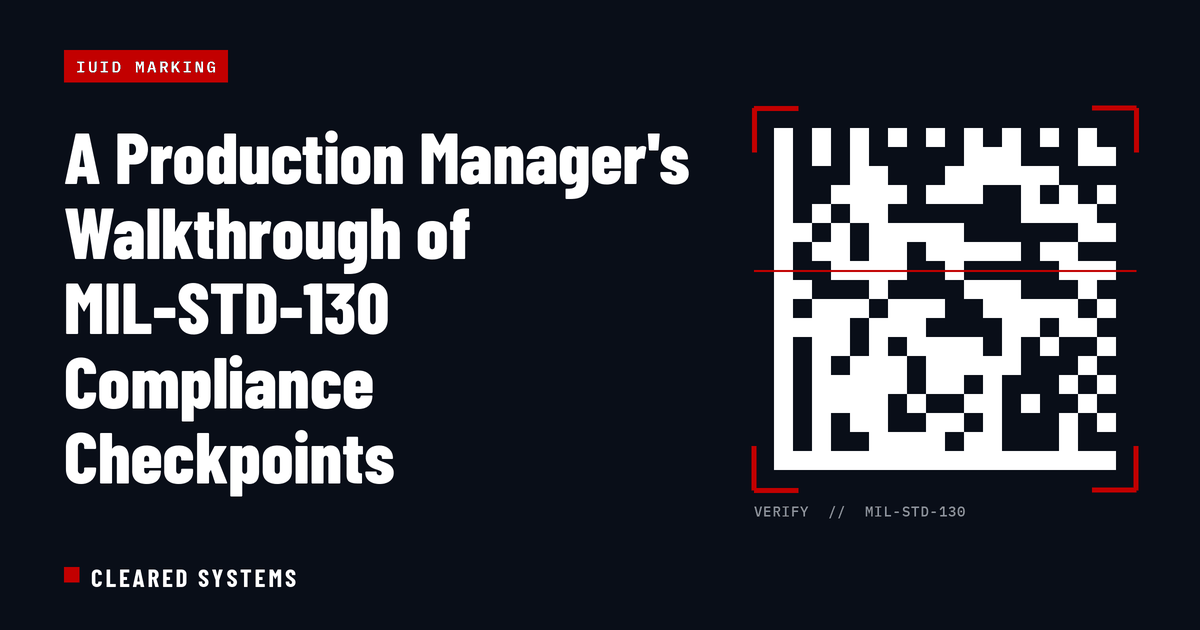
MIL-STD-130 specifies that the UII must be encoded in a two-dimensional Data Matrix symbol conforming to ISO/IEC 16022, and the mark must meet specific quality and durability requirements. This is where production line decisions have direct compliance consequences.
Marking method selection depends on the substrate, the item's operational environment, and the permanence requirements in the contract. Approved marking methods include:
- Direct Part Marking (DPM): Laser etching, dot peen, electrochemical etching, and ink jet are common DPM methods. Each has substrate compatibility requirements and minimum symbol quality grades.
- Label-based marking: Permitted in specific circumstances, but labels must meet durability standards appropriate for the item's use environment. Labels are generally not acceptable as the primary mark on items subject to harsh operating conditions.
- Nameplates and data plates: Used for larger assemblies where DPM is impractical, these must be attached in a manner that makes removal or loss evident.
Symbol quality verification is a checkpoint that many production teams underinvest in. MIL-STD-130 requires that Data Matrix symbols achieve a minimum quality grade when read by a verifier conforming to ISO/IEC 15415. Grade verification should be performed as part of in-process quality control, not only at final inspection. A symbol that passes visual inspection can still fail electronic verification—and a failed read at the receiving dock will trigger a nonconformance.
Checkpoint 4: Verify Mark Placement and Legibility Requirements
Beyond the technical construction of the UII, MIL-STD-130 specifies placement requirements that production must actively control. The mark must be applied to the item itself, not only to its packaging. It must be accessible for scanning without disassembly under normal operating conditions. And it must include human-readable text adjacent to the Data Matrix symbol that allows visual verification of key data elements.
Placement decisions that seem reasonable on the production floor can create field-level problems. Consider these common failure modes:
- Marks placed on surfaces that are obscured when the item is installed in its host system
- Human-readable text that is truncated or formatted inconsistently with the encoded data
- Mark placement that conflicts with other required markings, such as hazard warnings or handling instructions
A production manager's walkthrough of the final assembly should specifically include a verification step where the mark is scanned in a configuration as close as possible to its installed state. If you cannot read the mark without removing the item from its assembly, the placement is likely nonconforming.
Checkpoint 5: Register the Item in the DoD IUID Registry
Applying the physical mark is necessary but not sufficient for MIL-STD-130 compliance. The UII and associated item data must be submitted to the DoD Item Unique Identification Registry before or concurrent with item delivery. The registry submission is the mechanism through which the government gains visibility into the item's identity, and it ties the physical mark to the contractual and logistics data that makes the entire IUID system function.
Registry submissions are made through the Wide Area Workflow (WAWF) system using the IUID XML schema, or through equivalent electronic data interchange methods specified in the contract. The submission package must include:
- The UII for each serialized item
- The applicable contract number and line item
- Part number, description, and unit of measure
- Acquisition cost and enterprise identifier
- Parent-child relationship data for embedded items
Registry submission errors are one of the most frequently cited IUID nonconformances in government receiving inspections. Data mismatches between the physical mark and the registry record—even minor formatting inconsistencies—can result in items being held at receiving until the discrepancy is resolved. Building a submission validation step into your shipping workflow, before goods leave the dock, is a practical control that eliminates a significant source of delivery delays.
Checkpoint 6: Document and Retain IUID Records
MIL-STD-130 compliance does not end at shipment. Contractors are required to maintain records sufficient to demonstrate that marking and registration requirements were met. These records support government audits, property accountability actions, and warranty or repair tracking throughout the item's service life.
Your IUID records program should include at minimum:
- UII assignment logs with serial number ranges and production dates
- Symbol quality verification records including grade scores and equipment calibration data
- Registry submission confirmations and acknowledgment records from WAWF
- Nonconformance reports and corrective action records for any marking or registration failures
- Configuration change records where marking was required as a result of item modification
Connecting IUID documentation requirements to your broader compliance program development effort pays dividends when government property audits or contract closeout reviews occur. Organizations building or maturing their compliance infrastructure may benefit from reviewing how Compliance Program Development services can establish defensible documentation systems across multiple regulatory obligations simultaneously.
Where MIL-STD-130 Compliance Intersects With Other Defense Requirements
Production managers operating in the defense industrial base rarely work within a single compliance framework. MIL-STD-130 marking requirements intersect with several other obligations that the same team is typically managing.
DFARS clause 252.211-7003 is the contractual mandate that operationalizes IUID requirements, and it flows down to subcontractors who provide embedded items. If your supply chain includes sub-tier suppliers delivering components that meet the marking threshold, you are responsible for ensuring they comply—or for applying the marks yourself before delivery to the government.
For contractors also managing Controlled Unclassified Information on the shop floor, the intersection of physical asset marking and information security controls is worth examining. Physical access controls, handling procedures, and audit trails for IUID-marked items often overlap with CUI protection requirements. Teams navigating both simultaneously should review CMMC, CUI & DFARS Compliance support options that address the full scope of defense contractor obligations.
Manufacturers with ITAR-controlled items in their production environment face an additional layer of complexity. Items subject to both ITAR and IUID requirements must have marking and handling procedures that satisfy both frameworks without creating conflicts in how items are processed, stored, or shipped. The aerospace and defense sector commonly manages this intersection, and the procedural coordination required should be built into the production control system rather than managed as a manual exception process.
Building a Repeatable MIL-STD-130 Compliance Process
The checkpoints described above are not one-time events. Each new contract, each new item configuration, and each production run introduces the potential for a compliance gap if the process relies on tribal knowledge rather than documented procedure.
Production managers who have built effective MIL-STD-130 compliance systems share several practices. They maintain an IUID item register that is updated at the start of each contract, well before marking decisions reach the floor. They treat symbol verification equipment as calibrated test equipment with documented maintenance records. They conduct periodic internal audits of registry submission accuracy, comparing physical marks against registry records on a sample basis. And they have a defined corrective action process for marking nonconformances that includes root cause analysis and preventive action—not just rework.
These elements should be codified in a written procedure that production staff can follow consistently, with defined responsibilities, acceptance criteria, and escalation paths when nonconformances are identified.
Work With Cleared Systems on Your IUID Compliance Program
If your organization is working through MIL-STD-130 compliance for the first time, preparing for a government receiving inspection, or trying to resolve a pattern of IUID nonconformances, Cleared Systems can help. Our IUID Marking Verification & Compliance Support service is designed specifically for defense contractors who need practical, production-floor-level guidance—not just a policy review. To learn how we structure engagements and what an IUID support program typically includes, visit our engagement models page or request a quote to start a conversation about your specific program requirements.