
Why Your GLBA Compliance Services Provider's Currency Matters More Than Ever
The Gramm-Leach-Bliley Act has been a cornerstone of financial data protection for decades, but the regulatory environment surrounding it has shifted considerably in recent years. The Federal Trade Commission's updated Safeguards Rule introduced substantive new requirements for non-bank financial institutions, and enforcement posture has hardened across the board. If your GLBA compliance services provider is still working from a pre-2023 playbook, your organization is carrying risk it may not fully recognize.
The question compliance managers and executives should be asking is not simply whether their provider has GLBA experience. The more important question is whether that provider is actively tracking regulatory changes, translating them into updated guidance, and reflecting those updates in the work they deliver to your organization. This post gives you a practical framework for making that determination.
Signs a Provider Is Keeping Pace With GLBA Regulatory Changes
They Reference Specific Rule Updates, Not Just General Principles
A provider that is current with GLBA requirements will speak precisely about what has changed and when. They should be referencing the FTC Safeguards Rule amendments, the expanded definition of financial institution, the specific technical safeguards now required, and how those requirements interact with your existing information security program. If your provider speaks only in generalities, that is a signal worth investigating.
Ask your provider directly: what regulatory changes have occurred in the past eighteen months that affected the advice they gave you? A well-prepared provider should be able to answer that question specifically and connect those changes to deliverables in your engagement.
Their Deliverables Reflect Current Requirements, Not Templates From Three Years Ago
Policies, risk assessments, and program documentation that were accurate in 2021 may contain gaps today. The updated Safeguards Rule introduced requirements around multifactor authentication, encryption, access controls, and the designation of a qualified individual to oversee the information security program. If the policies your provider delivered do not reflect these specifics, they may be working from outdated templates.
Request a written explanation of how each deliverable maps to current regulatory requirements. A provider operating at a professional standard should be able to produce that mapping without significant preparation time. If they cannot, that tells you something important about how they maintain their own regulatory knowledge base.
They Proactively Communicate Regulatory Developments to Clients
Regulatory compliance is not a project that ends at delivery. A provider that is genuinely invested in your compliance posture will notify you when rules change, when enforcement actions signal new priorities, or when agency guidance updates affect your program. If you are learning about regulatory developments from industry publications rather than from your provider, that gap represents a service deficiency.
Consider whether your engagement model includes ongoing advisory support or whether it is structured as a one-time engagement. Organizations that need sustained compliance coverage often benefit from a Regulatory vCISO services model, which embeds ongoing regulatory awareness into the relationship rather than treating compliance as a point-in-time project.
Their Risk Assessment Methodology Addresses Current Threat Landscapes
GLBA requires covered institutions to implement a risk assessment process that identifies reasonably foreseeable internal and external risks. A provider keeping pace with the regulatory environment will design risk assessments that reflect the threats financial institutions actually face today, including third-party service provider risks, cloud environment exposures, and social engineering attacks targeting financial data.
If your last risk assessment was conducted more than a year ago and has not been revisited, your provider may not be meeting the ongoing assessment expectations embedded in the updated Safeguards Rule. Federal and SLED risk assessment methodologies that align to current standards can provide a useful benchmark for evaluating whether your GLBA risk assessment is sufficiently rigorous.
Red Flags That Suggest Your Provider Has Fallen Behind
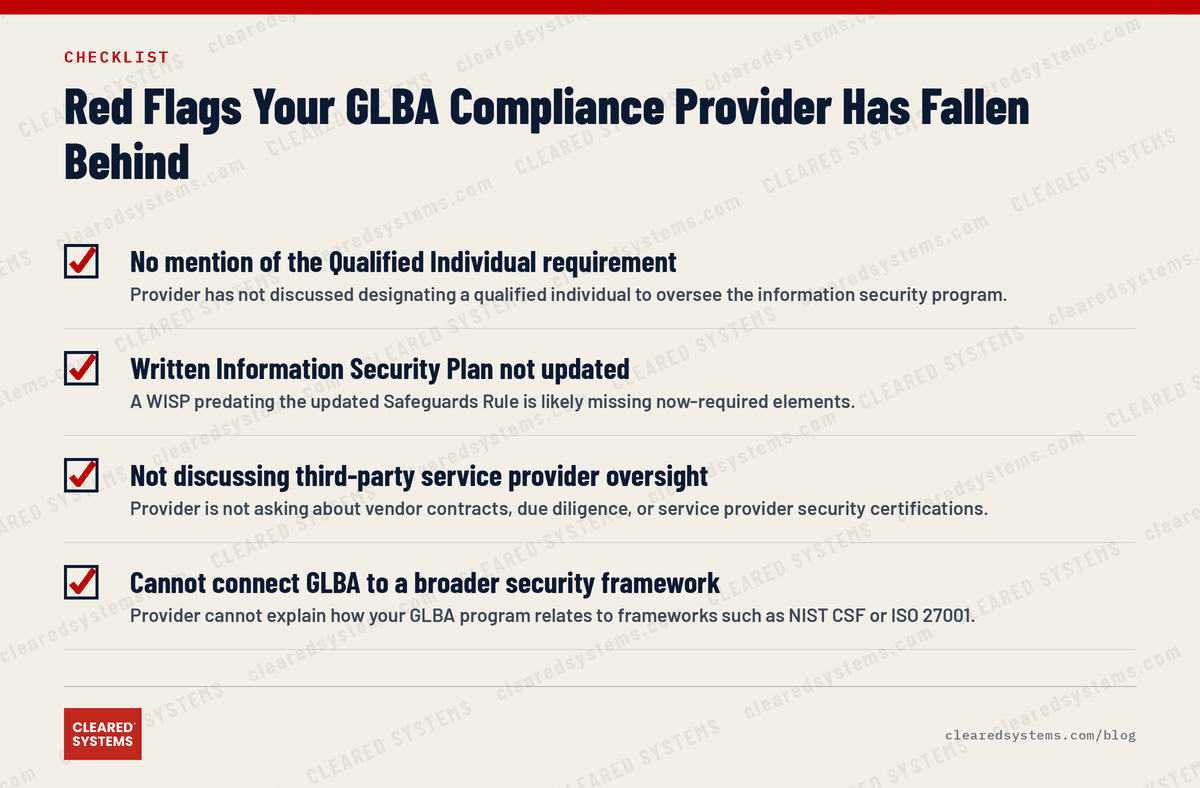
They Have Not Mentioned the Qualified Individual Requirement
The updated FTC Safeguards Rule requires covered non-bank financial institutions to designate a qualified individual responsible for overseeing and implementing the information security program. This individual must report to the board of directors or a senior officer at least annually. If your provider has not discussed this requirement with you and helped you document how it is satisfied in your organization, that is a meaningful gap.
Their Written Information Security Plan Has Not Been Updated
A Written Information Security Plan that predates the updated Safeguards Rule is likely missing required elements. The plan must now address specific administrative, technical, and physical safeguards that the amended rule made explicit. If you are unsure whether your WISP reflects current requirements, our prior post on how to develop a comprehensive Written Information Security Plan provides useful context for evaluating what a current document should include.
They Are Not Discussing Third-Party Service Provider Oversight
The updated Safeguards Rule explicitly requires institutions to oversee their service providers and ensure those providers implement appropriate safeguards. A provider that is not asking you about vendor contracts, due diligence processes, and service provider security certifications is not addressing a material compliance requirement. This is an area where many organizations have gaps, and a current provider should be surfacing it proactively.
They Cannot Connect GLBA Requirements to a Broader Security Framework
Sophisticated GLBA compliance programs do not exist in isolation. Organizations in the financial sector increasingly need to demonstrate alignment with recognized security frameworks as part of their compliance posture. A provider that cannot explain how your GLBA program relates to frameworks such as the NIST Cybersecurity Framework or ISO 27001 may not be bringing the depth of expertise your organization needs. Our resource on ISO 27001 compliance and risk management illustrates how structured security frameworks support and reinforce regulatory compliance programs.
Questions to Ask Your Provider During Your Next Review
- What regulatory changes affecting GLBA compliance have occurred in the past twelve months, and how have you reflected those changes in our program?
- How do you monitor FTC enforcement actions and guidance updates, and how does that monitoring translate into client advisories?
- When did you last review our Written Information Security Plan against current Safeguards Rule requirements, and what changes did that review produce?
- How does our current program address the qualified individual reporting requirement?
- What third-party service provider oversight documentation do we have on file, and does it satisfy current regulatory expectations?
- Have you reviewed our program against the most recent FTC examination priorities for financial data protection?
A provider that cannot answer these questions clearly and specifically is not delivering what your organization needs. These are not trick questions. They are the basic competency expectations for a provider holding themselves out as a GLBA compliance specialist.
What a High-Quality GLBA Compliance Services Engagement Should Include
High-quality IT compliance services for financial institutions subject to GLBA should encompass more than document delivery. A well-structured engagement typically addresses risk assessment design and execution, program documentation aligned to current requirements, qualified individual designation support, board-level reporting templates, vendor oversight program development, incident response planning, and ongoing regulatory monitoring.
The financial institutions we work with often come to us after discovering that their previous provider delivered documentation without building the underlying program infrastructure. Documentation without program substance does not hold up under examination, and it does not protect the organization when something goes wrong.
A strong engagement also connects GLBA requirements to your broader compliance program development effort. Financial institutions that handle data intersecting with other regulatory frameworks need a provider who can reason across those frameworks rather than treating each one as a separate silo.
The Role of Ongoing Advisory in Regulatory Currency
One of the most common reasons organizations find themselves behind on GLBA requirements is that they structured their compliance engagement as a one-time project rather than an ongoing relationship. Regulations change. Enforcement priorities shift. What satisfied an examination two years ago may not satisfy one today.
Organizations that want to stay ahead of GLBA regulatory changes should consider whether their current provider relationship includes a mechanism for ongoing advisory, regulatory monitoring, and periodic program review. If it does not, that is a structural gap in how compliance is being managed, not just a gap in any single deliverable.
The question of whether to build that capacity internally or through an outsourced provider is worth examining carefully. Our discussion of GLBA compliance services in 2026 provides additional context on how the FTC Safeguards Rule amendments have reshaped what a current engagement should look like.
Take the Next Step
If you have questions about whether your current GLBA compliance program reflects current FTC Safeguards Rule requirements, or if you are evaluating providers and want to understand what a rigorous engagement should include, Cleared Systems can help. We work with financial institutions, defense contractors, and regulated organizations across industries to build and maintain compliance programs that hold up under scrutiny. Visit our request a quote page to start a conversation about your organization's specific situation.