
Why an ITAR Training Calendar Is Not Optional
Many defense contractors treat ITAR compliance training as a one-time onboarding event or an annual checkbox. That approach consistently fails during DDTC examinations. Regulators expect to see evidence of a structured, recurring, role-differentiated training program — not a single slide deck delivered at new hire orientation.
A formal training calendar does two things simultaneously. It ensures your workforce stays current on the rules that govern what they touch every day, and it creates the documented evidence trail auditors need to confirm that your program is active and operational. Without a calendar, you have neither.
This post walks through how to build an ITAR & Export Controls Compliance training calendar that maps required topics to the right audiences, schedules them at defensible intervals, and produces the records your program depends on.
Start with a Topic Inventory Before You Schedule Anything
Before you assign dates, you need a complete list of the subjects your training program must address. Many organizations discover gaps here — they cover the basics but miss the operational topics that actually drive violations.
Your topic inventory should include at minimum:
- ITAR fundamentals: What the International Traffic in Arms Regulations cover, how the United States Munitions List is organized, and the difference between ITAR and EAR jurisdiction
- Technical data identification and marking: How to recognize ITAR-controlled technical data, how to label it correctly, and what constitutes an unauthorized export of data
- License requirements and exemptions: When a license is required, which exemptions apply to your operations, and how to document their use
- Foreign national requirements: The deemed export rule, how to screen employees and visitors, and what access restrictions apply to foreign nationals
- Visitor control and badging: ITAR facility visitor protocols, documentation requirements, and how badging systems support access control
- Recordkeeping obligations: What records must be kept, in what format, and for how long under Part 122 and Part 130 of the ITAR
- Voluntary disclosure and incident reporting: When and how to report potential violations, the internal escalation process, and the consequences of non-disclosure
- Cyber and cloud considerations: How ITAR obligations apply to data stored or transmitted in cloud environments, and what platform requirements exist
- Role-specific scenarios: Practical examples tailored to engineering, manufacturing, contracts, shipping, HR, and executive leadership
If you are unsure whether your current training topics are comprehensive, our post on structuring an ITAR compliance training program that actually changes behavior provides a useful framework for auditing your existing curriculum.
Assign Topics to Roles, Not Just Departments
A common structural error is treating ITAR training as a single uniform program delivered to everyone in the company. The result is that engineers sit through content about export licensing procedures they will never use, while contracts personnel receive nothing about the technical data they handle constantly.
Effective calendars segment training by role:
- All employees: ITAR fundamentals, awareness of controlled items and data, how to escalate questions or concerns
- Engineers and technical staff: Technical data identification, marking requirements, cloud and collaboration tool restrictions, deemed export awareness
- Manufacturing and production personnel: Physical access controls, handling of ITAR-controlled hardware, shipping and transfer protocols
- Contracts and business development: License review, end-use and end-user screening, flow-down obligations to subcontractors
- Human resources: Foreign national hiring procedures, employment screening, the deemed export rule in practice
- Facility and security personnel: Visitor control, badging requirements, access authorization records
- Managers and supervisors: Oversight responsibilities, how to respond to employee questions, incident escalation authority
- Executives: Personal liability exposure, organizational accountability, voluntary disclosure decision-making
For a detailed breakdown of what supervisors specifically need to understand, see our post on ITAR training for managers and what supervisors must know to protect the company.
Build the Calendar Structure Around Required Intervals
The ITAR does not prescribe a specific training frequency, but DDTC consent agreements and enforcement guidance make clear what a defensible program looks like. Build your calendar around these intervals:
Annual Training — Required for All Personnel
Every person with access to ITAR-controlled items, technical data, or controlled facilities should complete a full training cycle at least once per year. Annual training is the floor, not the ceiling.
New Hire Training — Before Access Is Granted
Onboarding training must occur before a new employee is given access to any ITAR-controlled material, technical data, or restricted areas. Document the completion date and what was covered. This applies to contractors, temps, and consultants as well as direct hires.
Triggered Training — When Circumstances Change
Your calendar should include triggered training modules deployed in response to specific events: a regulatory change, a near-miss or violation, a new contract with unusual requirements, a merger or acquisition, or a significant change to your IT environment. Build placeholder slots into your calendar on a quarterly basis so triggered training can be deployed quickly when needed.
Role Change Training — When Responsibilities Shift
An employee moving from an administrative role to an engineering role that involves technical data access needs updated training before the transition. Your calendar should include a process for identifying and scheduling this training whenever personnel move into roles with elevated ITAR exposure.
Schedule by Quarter, Not by Year
Organizations that build annual training calendars in January and then do nothing until December consistently miss training windows and create documentation gaps. A quarterly structure forces regular checkpoints.
A practical quarterly framework looks like this:
- Q1: Annual all-hands ITAR fundamentals and awareness training; update foreign national access reviews; confirm recordkeeping procedures are current
- Q2: Role-specific deep dives for engineering and technical staff; licensing and exemption training for contracts and BD personnel; review cloud and collaboration tool policies
- Q3: Manager and supervisor training; facility and visitor control refresher; tabletop exercise for incident response and voluntary disclosure escalation
- Q4: Executive briefing on ITAR obligations and enforcement trends; audit-readiness training for compliance staff; records review and calendar planning for the following year
Layering triggered and role-change modules on top of this quarterly skeleton gives you a calendar that is both predictable and responsive.
Documentation Requirements That Auditors Actually Check
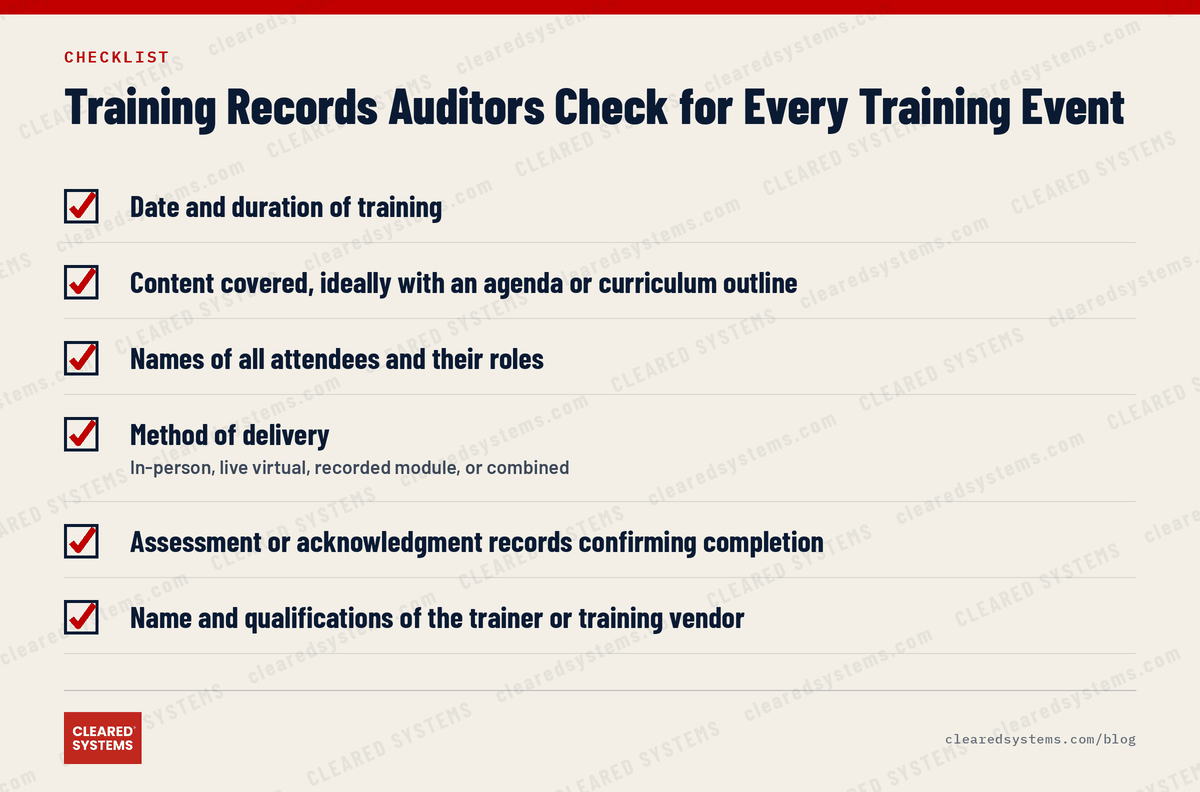
A training program that cannot be documented is a program that does not exist from DDTC's perspective. For every training event, your records should capture:
- Date and duration of training
- Content covered, ideally with an agenda or curriculum outline
- Names of all attendees and their roles
- Method of delivery — in-person, live virtual, recorded module, or combined
- Assessment or acknowledgment records confirming completion
- Name and qualifications of the trainer or training vendor
These records must be retained in accordance with your ITAR recordkeeping obligations. If your recordkeeping infrastructure is not yet in place, our post on ITAR recordkeeping requirements covers what to keep, for how long, and in what format.
Connecting Training to Your Broader Compliance Program
A training calendar does not operate in isolation. It should be integrated with your Technology Control Plan, your visitor control procedures, your foreign national management processes, and your incident response protocols. Gaps in any of those areas tend to surface first in training reviews — which is one reason auditors spend significant time on training documentation.
If your organization is building or rebuilding its ITAR program from the ground up, our Compliance Program Development service addresses the full architecture, including how training integrates with policy, recordkeeping, and access control.
Organizations in the aerospace and defense manufacturing space face particularly complex training requirements given the volume and variety of ITAR-controlled items they handle. Our Aerospace & Defense industry page outlines how we approach compliance programs in that environment.
For executives preparing to present on or be held accountable for ITAR program performance, the upcoming ITAR Executive Oversight & International Business Risk session addresses what leadership needs to own and understand.
Common Training Calendar Failures to Avoid
Based on what we see during compliance assessments, these are the most frequent structural problems in ITAR training calendars:
- Treating all employees identically: One-size-fits-all training leaves high-risk roles under-trained and wastes time for everyone else
- No process for onboarding training: New hires gaining access before completing training is one of the fastest paths to a deemed export violation
- Missing documentation: Completion records are either not collected or not retained long enough to satisfy DDTC requirements
- No triggered training process: Regulatory changes and near-misses pass without any corresponding update to what employees are taught
- Training without assessment: Attendance is logged but comprehension is never tested, making it difficult to demonstrate that employees actually understood the material
For a detailed look at how training failures connect to enforcement actions, our post on the top five ITAR compliance training mistakes that lead to enforcement actions is worth reviewing before you finalize your calendar.
Take the Next Step with Cleared Systems
Building a defensible ITAR compliance training calendar requires more than good intentions — it requires a structured methodology, role-specific content, and documentation practices that hold up under regulatory scrutiny. Cleared Systems works with defense contractors, manufacturers, and federal vendors to design and implement ITAR training programs that satisfy DDTC expectations and integrate seamlessly with the broader compliance program. Visit our ITAR & Export Controls Compliance service page to learn what we cover, or request a quote to start a conversation about your program's training gaps.