
The Real Question Behind the Budget Line
Every compliance manager I speak with eventually arrives at the same crossroads: do we hire staff and build this internally, or do we engage a managed cloud compliance services provider and move faster? On the surface, the in-house model feels like control. In practice, it often delivers cost overruns, coverage gaps, and a team that cannot keep pace with a regulatory environment that changes quarterly.
This post lays out a practical cost comparison. It is not an argument for outsourcing at any price. It is a framework for making a defensible decision — the kind you can present to a CFO, a contracting officer, or a DCSA assessor without flinching.
What "In-House Compliance" Actually Costs
Organizations routinely underestimate the fully loaded cost of an internal compliance function. The salary line is only the beginning.
Personnel Costs
A mid-level compliance manager with CMMC, DFARS, and NIST 800-171 depth commands a substantial salary in today's market, and that figure does not include benefits, payroll taxes, recruiting fees, or the six to twelve months of onboarding time before the hire is operating independently. Senior practitioners with hands-on regulatory vCISO-level expertise command premium compensation that many small and mid-size defense contractors cannot sustain on a single headcount.
Add a second hire to cover IT compliance implementation — policy development, system configuration, audit evidence management — and your personnel budget doubles before you have addressed training, certification maintenance, or vacation coverage.
Tools and Technology
An in-house team needs a governance, risk, and compliance platform; a document management system; endpoint monitoring tools; and, for contractors handling Controlled Unclassified Information, a compliant cloud environment. For defense contractors pursuing CMMC Level 2 or above, that environment is typically Microsoft GCC High, which carries its own licensing and configuration costs on top of whatever commercial Microsoft 365 environment you are already running.
Licensing, configuration, and ongoing administration of a compliant Microsoft 365 GCC High tenant is not a one-time project. It requires continuous monitoring, policy updates, and documented evidence trails — work that falls directly on your in-house staff or goes undone.
Training and Certification
CMMC 2.0, NIST SP 800-171, DFARS 252.204-7012, and ITAR all evolve. Keeping an internal team current requires annual training investments, conference attendance, and subscription to regulatory update services. Certifications lapse. When a credentialed employee leaves, the institutional knowledge walks out the door with them.
Hidden Costs: Gaps and Incidents
The most expensive in-house compliance failures are the ones that do not show up until an audit. A missed System Security Plan update, an incomplete POA&M, or a misconfigured conditional access policy in GCC High can translate directly into a failed assessment, a contract hold, or a DCSA finding. These costs are difficult to forecast but very easy to experience.
What Managed Cloud Compliance Services Actually Deliver
Managed IT compliance services and cloud compliance engagements are structured differently from staff augmentation. You are not renting a body. You are contracting access to a team with cross-functional depth — compliance architects, cloud engineers, policy writers, and regulatory specialists — who work across multiple client environments and stay current because their business depends on it.
Scope and Coverage
A well-structured managed cloud compliance engagement covers the functions that in-house teams struggle to staff: gap assessments against NIST 800-171 and CMMC, GCC High tenant configuration and ongoing hardening, CUI boundary documentation, System Security Plan development and maintenance, and continuous monitoring. Some engagements extend to CMMC, CUI, and DFARS compliance program management as a standing retainer rather than a point-in-time project.
For organizations that also carry ITAR obligations, managed providers with ITAR and export controls compliance capability can integrate those requirements into the same program rather than forcing you to manage two separate compliance tracks with two separate internal leads.
Cost Structure
Managed cloud compliance services are typically structured as monthly or annual retainers, project-based engagements, or a hybrid of both. The key financial advantage is predictability. You are not absorbing salary risk, benefits overhead, or the cost of a compliance gap created by employee turnover. You are paying for defined deliverables with defined accountability.
For organizations that need executive-level compliance leadership without the cost of a full-time hire, a Regulatory vCISO engagement provides a fractional CISO who understands the federal contractor regulatory environment and can interface directly with auditors, contracting officers, and your board.
The GCC High Variable
Microsoft GCC High is the cloud environment required for most organizations handling CUI under DFARS 252.204-7012 and CMMC Level 2. It is also one of the most consistently misconfigured environments in the defense industrial base. In-house IT teams frequently inherit a GCC High tenant that was stood up quickly to meet a contract requirement and never properly hardened or documented.
Managed cloud compliance providers who specialize in the federal contractor space bring GCC High configuration expertise that general IT staff rarely possess. This includes conditional access policy design, Microsoft Purview labeling for CUI, Defender for Endpoint hardening, and the audit log configurations that CMMC assessors look for during a C3PAO review. You can read more about how these configurations support compliance in our post on Microsoft Office 365 GCC High features that enable CMMC compliance.
The cost of getting GCC High wrong in an in-house model is not just the remediation expense. It is the failed assessment, the contract delay, and the reputational damage with a prime contractor or government customer.
Side-by-Side: Where the Numbers Land
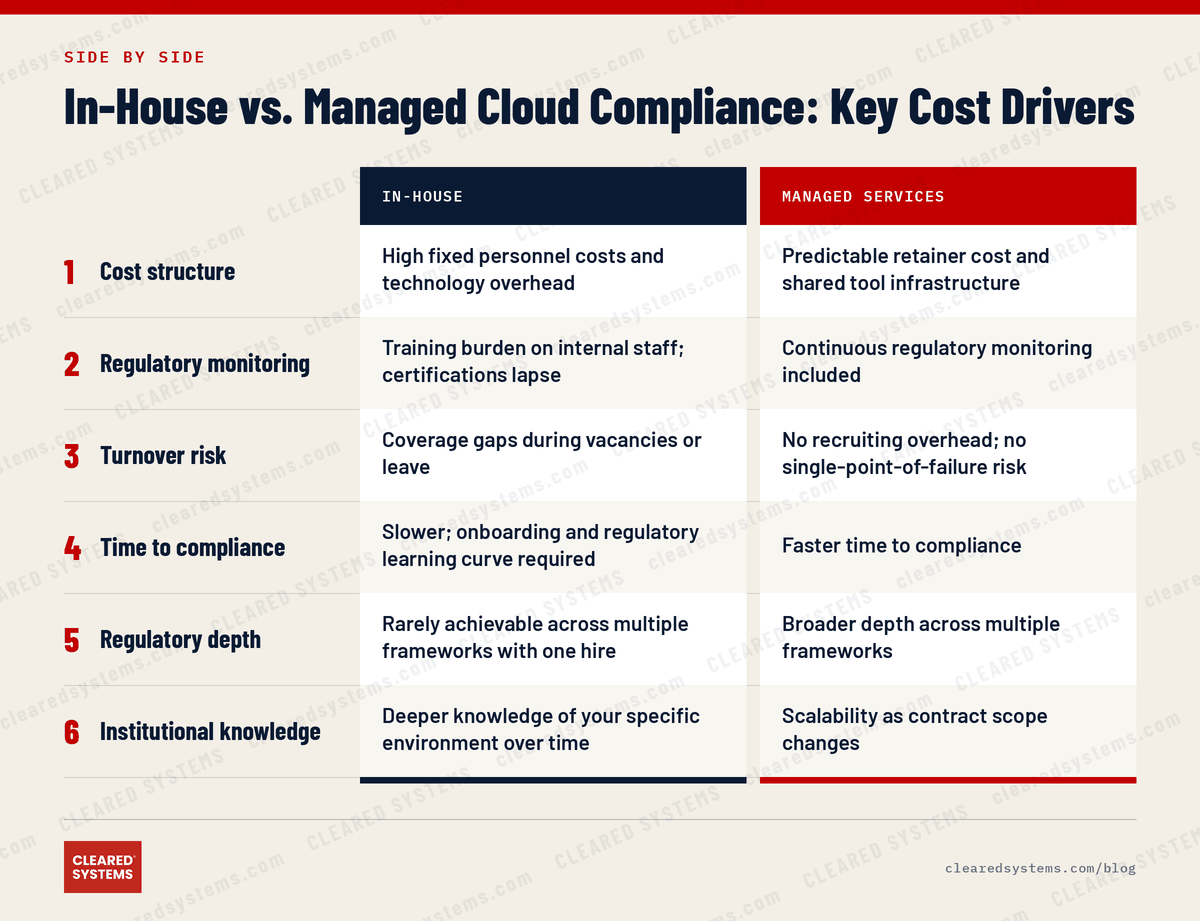
Rather than publish figures that become outdated, consider the structural cost drivers in each model:
- In-house: High fixed personnel costs, technology overhead, training burden, turnover risk, and coverage gaps during vacancies or leave.
- Managed services: Predictable retainer cost, shared tool infrastructure, continuous regulatory monitoring, and scalability as contract scope changes.
- In-house advantage: Deeper institutional knowledge of your specific environment over time; direct control over priorities and timelines.
- Managed services advantage: Faster time to compliance, broader regulatory depth across multiple frameworks, reduced single-point-of-failure risk, and no recruiting overhead.
For small to mid-size defense contractors — particularly those under 300 employees — the managed model almost always delivers a lower total cost of compliance. For larger organizations with complex multi-site environments, a hybrid model often makes the most sense: a lean internal compliance function supported by a managed services provider for specialized domains like GCC High administration, ITAR, and CMMC audit readiness.
Building the Business Case Internally
If you are preparing a recommendation for your CFO or executive team, the conversation should center on three questions:
- What is the cost of a failed CMMC or DCSA assessment? Include contract revenue at risk, remediation costs, and timeline delays.
- What is the realistic time-to-competence for a new internal hire? Factor in recruiting, onboarding, and the regulatory learning curve.
- What frameworks do we actually need to cover? An organization with CMMC, ITAR, and DFARS obligations needs depth across all three. That is rarely achievable with a single internal hire.
A structured compliance program development engagement can answer all three questions with documented evidence — something a job posting cannot.
For organizations that need a broader view of risk posture before committing to a compliance model, a Federal and SLED risk assessment provides the baseline data needed to scope the right solution.
What Cleared Systems Offers
Cleared Systems provides managed cloud compliance services designed specifically for defense contractors, federal agencies, and regulated industries navigating CMMC, DFARS, GCC High, ITAR, and related frameworks. Our engagements are structured around your specific contract obligations, not a generic checklist. We work directly with your IT environment, your documentation, and your assessors — so that compliance is a business asset, not a recurring fire drill.
Visit our IT compliance services page to understand what a managed engagement includes, and explore our engagement models to find the structure that fits your organization's size, budget, and compliance timeline.
If you are ready to move from cost uncertainty to a defined compliance roadmap, request a quote and a member of our team will follow up to scope the right engagement for your situation.