
Why ROI Belongs in the Export Compliance Conversation
When compliance managers bring an ITAR and export controls compliance engagement to the leadership table for budget approval, the conversation almost always turns to cost. That is the wrong starting point. The more productive question is not what the engagement costs — it is what noncompliance, enforcement action, or a lost contract would cost instead.
Measuring return on investment from export compliance consulting is not as straightforward as calculating revenue from a new product line, but it is entirely achievable. The key is knowing which metrics to track, which risks to monetize, and how to frame the results for executives and boards who need to justify the spend. This post walks through a practical framework for doing exactly that.
The True Cost Baseline: What You Are Measuring Against
Before you can calculate ROI, you need an honest baseline of what unmanaged export compliance risk actually exposes your organization to. That baseline has several components.
Regulatory Penalties and Enforcement Costs
ITAR violations resolved through the State Department's Directorate of Defense Trade Controls can result in civil penalties reaching into the millions of dollars per violation, criminal referrals for willful violations, and consent agreements that impose years of oversight and mandatory compliance spending. EAR violations resolved through the Bureau of Industry and Security carry similar exposure. These are not theoretical risks. Enforcement actions are publicly documented and ongoing across the defense industrial base.
Your baseline should include a realistic estimate of your organization's exposure given its current compliance posture. A gap assessment conducted as part of an export controls compliance engagement produces exactly this kind of documented risk inventory, which becomes the foundation of your ROI calculation.
Contract Loss and Business Development Risk
Defense prime contractors and federal agencies are increasingly requiring demonstrated export compliance programs from their suppliers. A manufacturer or distributor that cannot show a functioning compliance program — written policies, trained personnel, documented screening processes — risks losing bid opportunities or being removed from an approved supplier list. For companies operating in aerospace and defense, that exposure can dwarf the cost of any consulting engagement within a single contract cycle.
Operational Disruption Costs
When DDTC or BIS initiates a voluntary disclosure review or administrative inquiry, internal resources are consumed at a significant rate. Legal fees, management time, internal audit diversions, and the cost of remediation under regulatory scrutiny are all substantially higher than the cost of proactive compliance work. Quantifying even a conservative estimate of this operational disruption risk strengthens the ROI case considerably.
Four Categories of Measurable Return
Once you have established a credible cost baseline, the ROI calculation shifts to quantifying what a consulting engagement actually delivers. Experienced compliance managers typically look at four categories.
1. Risk Avoidance Value
This is the most direct ROI metric. If a consulting engagement identifies a gap — an unlicensed deemed export, a foreign national access control failure, a missing technology control plan — and that gap is remediated before an enforcement action, the value is the probability-weighted cost of the enforcement action that did not occur. Even conservative estimates of this calculation tend to produce returns that far exceed the cost of the engagement.
A well-structured ITAR compliance engagement typically includes a program assessment, gap identification, and remediation roadmap. Each documented gap closed is a risk avoidance metric you can record and report upward.
2. Contract Enablement and Revenue Protection
Some contracts simply cannot be won without a defensible compliance program in place. When an export compliance consulting engagement enables your organization to respond affirmatively to a prime contractor's supplier compliance questionnaire, or satisfy a contracting officer's pre-award compliance review, the revenue value of that contract is directly attributable — at least in part — to the compliance investment.
Track which contracts required demonstrated compliance capability as a condition of award. Even partial attribution to the compliance program gives you a credible revenue protection number that often makes the engagement cost look marginal in comparison.
3. Efficiency Gains and Internal Cost Avoidance
Organizations that build export compliance programs from scratch internally typically spend significant time on research, policy drafting, training development, and recordkeeping system design — time that comes at the opportunity cost of billable or mission-critical work. A consulting engagement that delivers ready-to-use policies, training frameworks, and program documentation compresses that timeline and reduces internal resource consumption.
Measure this by estimating how many hours of internal staff time the engagement replaced, multiplied by the loaded hourly cost of that staff. For manufacturing and defense contractors, this efficiency calculation alone frequently approaches the engagement cost within the first year.
4. Audit Readiness and Examination Cost Reduction
Companies with mature, documented compliance programs fare better in DDTC examinations and third-party audits than those responding reactively. A consulting engagement that produces a comprehensive program — policies, training records, commodity jurisdiction determinations, license tracking, visitor controls, and recordkeeping systems — reduces the cost and disruption of any subsequent examination. It also supports a more favorable outcome if a voluntary disclosure is ever necessary.
For manufacturers and others facing periodic supply chain audits, the cost of an unstructured, reactive response to an audit request often exceeds the cost of the compliance program that would have made the response straightforward.
Building the ROI Presentation for Leadership
Compliance managers who successfully make the ROI case to executives typically frame the analysis in three parts: avoided downside, enabled upside, and operational efficiency. That structure maps cleanly to the categories above and gives finance-oriented executives the cost-benefit framing they expect.
Avoid presenting compliance ROI as an abstract concept. Anchor it to specific, documented gaps identified during the engagement, specific contracts that required compliance documentation, and specific internal hours consumed before versus after program implementation. The more concrete the numbers, the more credible the case.
It also helps to connect the export compliance program to the broader compliance infrastructure. Organizations that have invested in compliance program development across multiple regulatory domains often find that an export compliance engagement leverages existing governance structures — policy frameworks, training calendars, recordkeeping systems — which further reduces the marginal cost and increases the net return.
Tracking ROI Over Time
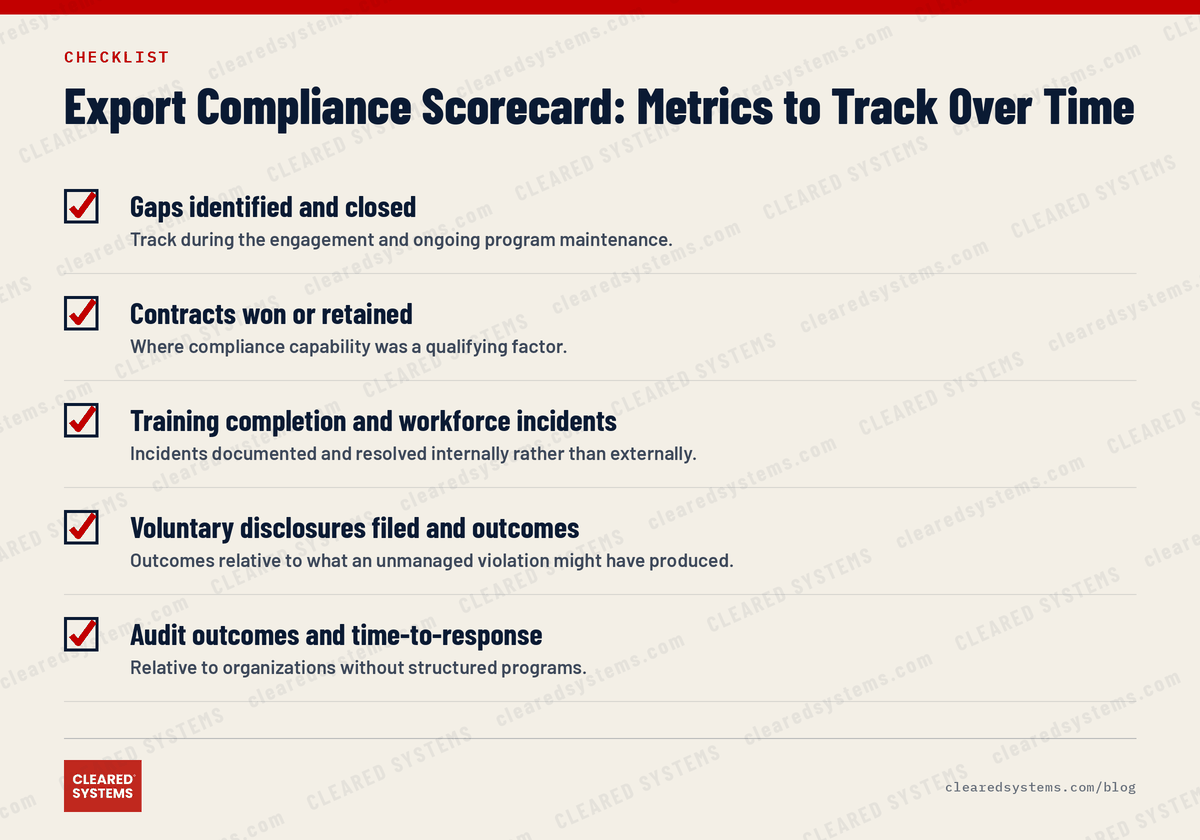
A single point-in-time ROI calculation is useful, but ongoing tracking is what sustains executive support for the compliance program budget over multiple years. Consider establishing a simple compliance scorecard that tracks the following on a quarterly or annual basis:
- Number of gaps identified and closed during the engagement and ongoing program maintenance
- Contracts won or retained where compliance capability was a qualifying factor
- Training completion rates and any workforce compliance incidents documented and resolved internally rather than externally
- Voluntary disclosures filed (if any) and their outcomes relative to what an unmanaged violation might have produced
- Audit or examination outcomes and time-to-response relative to organizations without structured programs
This ongoing scorecard transforms the compliance program from a cost center narrative into a performance narrative — which is precisely the framing that sustains budget and executive attention through personnel transitions and budget cycles.
For organizations also managing cybersecurity frameworks, the ROI methodology translates directly. Teams already tracking compliance program value under CMMC or DFARS requirements will find the export compliance ROI framework familiar. For further reading on how managing an ITAR and EAR export compliance program fits into broader compliance strategy, our blog provides additional practical guidance.
What to Expect from an Export Compliance Consulting Engagement
Not all consulting engagements are structured the same way, and the ROI you can capture depends significantly on scope. At Cleared Systems, our ITAR and export controls compliance services are designed to deliver the foundational elements that make ROI measurement possible: a documented baseline, a gap assessment, program development support, and training resources. Visit that page to understand what a Cleared Systems engagement includes and how it maps to the risk categories described above.
Organizations interested in understanding how our different service structures work can also review our engagement models, which describe the options available for ongoing compliance support versus project-based work.
The Bottom Line
Export compliance consulting is not a discretionary expense for defense contractors, aerospace suppliers, or manufacturers operating in regulated international markets. It is a risk management investment with quantifiable returns across enforcement avoidance, contract enablement, operational efficiency, and audit readiness. The organizations that measure and report those returns consistently are the ones that sustain compliance program investment through leadership transitions and budget pressures — and avoid the far greater costs that come with an unmanaged violation.
If you are ready to quantify the value of a structured export compliance program for your organization, request a quote from Cleared Systems and let us help you build the business case alongside the program itself.